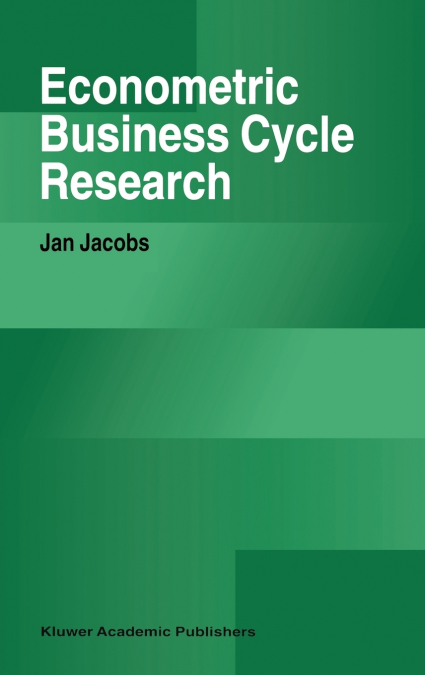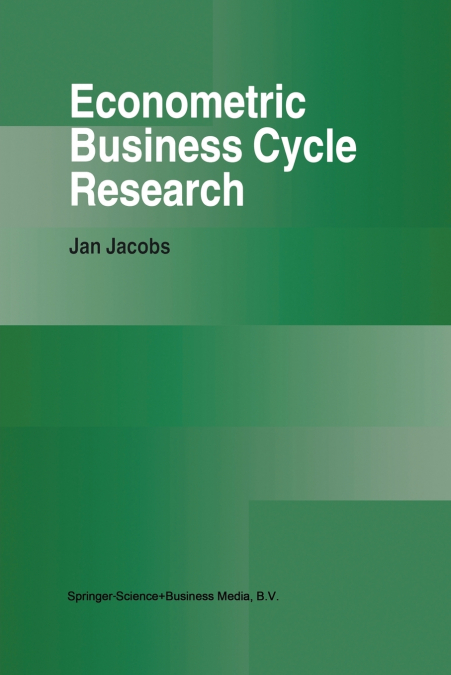

Econometric Business Cycle Research

Econometric Business Cycle Research

Jan Jacobs

134,11 €
IVA incluido
Disponible
Editorial:
Springer Nature B.V.
Año de edición:
2012
Materia
Macroeconomía
ISBN:
9781461375586
134,11 €
IVA incluido
Disponible

Selecciona una librería:

  • Librería Samer Atenea
  • Librería Aciertas (Toledo)
  • Kálamo Books
  • Librería Perelló (Valencia)
  • Librería Elías (Asturias)
  • Donde los libros
  • Librería Kolima (Madrid)
  • Librería Proteo (Málaga)

Econometric Business Cycle Research deals with econometric business cycle research (EBCR), a term introduced by the Nobel-laureate Jan Tinbergen for his econometric method of testing (economic) business cycle theories. EBCR combines economic theory and measurement in the study of business cycles, i.e., ups and downs in overall economic activity. We assess four methods of EBCR: business cycle indicators, simultaneous equations models, vector autoregressive systems and real business indicators. After a sketch of the history of the methods, we investigate whether the methods meet the goals of EBCR: the three traditional ones, description, forecasting and policy evaluation, and the one Tinbergen introduced, the implementation|testing of business cycles. The first three EBCR methods are illustrated for the Netherlands, a typical example of a small, open economy. The main conclusion of the book is that simultaneous equation models are the best vehicle for EBCR, if all its goals are to be attained simultaneously. This conclusion is based on a fairly detailed assessment of the methods and is not over-turned in the empirical illustrations. The main conclusion does not imply the end of other EBCR methods. Not all goals have to be met with a single vehicle, other methods might serve the purpose equally well - or even better. For example, if one is interested in business cycle forecasts, one might prefer a business cycle indicator or vector autoregressive system. A second conclusion is that many ideas/concepts that play an important role in current discussions about econometric methodology in general and EBCR in particular, were put forward in the 1930s and 1940s. A third conclusion is that it is difficult, if not impossible, to compare the outcomes of RBC models to outcomes of the other three methods, because RBC modellers are not interested in modelling business cycles on an observation-per-observation basis. A more general conclusion in this respect is that methods should adopt the same concept of business cycles to make them comparable.
Artículos relacionados

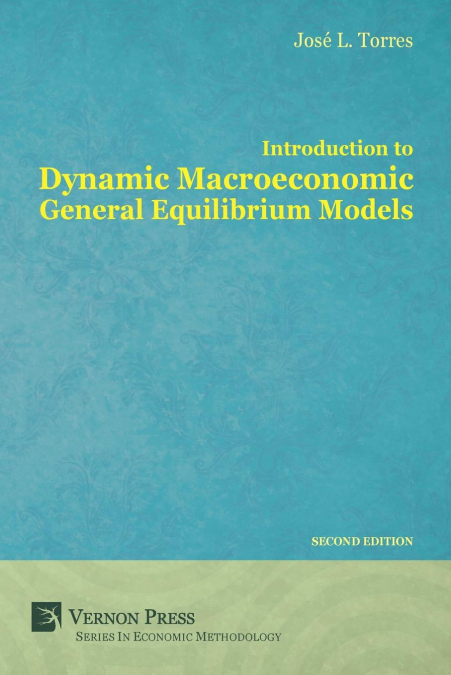
  • Introduction to Dynamic Macroeconomic General Equilibrium Models
    José Luis Torres Chacon
    This book offers an introductory step-by-step course in Dynamic Stochastic General Equilibrium modelling. Modern macroeconomic analysis is increasingly concerned with the construction, calibration and/or estimation and simulation of Dynamic General Equilibrium (DGE) models. The book is intended for graduate students as an introductory course to DGE modelling and for those econo...
    Disponible

    61,40 €

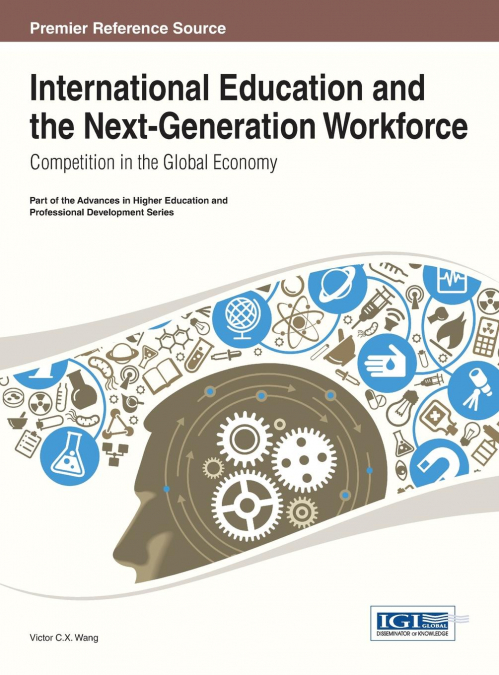
  • International Education and the Next-Generation Workforce
    Wei Wang
    Education is the first stage in developing a viable, dynamic, and long-lived global economy. Unfortunately, in times of economic hardship, educational programs, teacher salaries, and extracurricular opportunities are often the first to be cut. International Education and the Next-Generation Workforce: Competition in the Global Economy presents a detailed discussion of present e...
  • Macroeconomic Policies of Developed Democracies
    Robert J Franzese Jr
    ...
  • End Of The Road
    Louis Holder
    This book is about the mismanagement of Western economies in pursuit of political power, which resulting devastation will have to be borne by future generations. The book establishes that postponement is no longer doable and lays out the hard choices ahead causing much misery and agony.Although not fully recognized because of masking by asset bubbles, which are spun/sold as in...
    Disponible

    16,42 €

  • The Darwin Economy
    Robert H. Frank
    What Charles Darwin can teach us about building a fairer societyWho was the greater economist-Adam Smith or Charles Darwin? The question seems absurd. Darwin, after all, was a naturalist, not an economist. But Robert Frank, New York Times economics columnist and best-selling author of The Economic Naturalist, predicts that within the next century Darwin will unseat Smith as the...
    Disponible

    22,42 €

  • Myth and Measurement
    Alan B. Krueger / David Card
    From David Card, winner of the Nobel Prize in Economics, and Alan Krueger, a provocative challenge to conventional wisdom about the minimum wageDavid Card and Alan B. Krueger have already made national news with their pathbreaking research on the minimum wage. Here they present a powerful new challenge to the conventional view that higher minimum wages reduce jobs for low-wage ...
    Disponible

    39,64 €

Otros libros del autor

  • Econometric Business Cycle Research
    Jan Jacobs
    Econometric Business Cycle Research deals with econometric business cycle research (EBCR), a term introduced by the Nobel-laureate Jan Tinbergen for his econometric method of testing (economic) business cycle theories. EBCR combines economic theory and measurement in the study of business cycles, i.e., ups and downs in overall economic activity. ...