
Inicio > Humanidades > Filosofía > Ética y filosofía moral > Ecology and Justice-Citizenship in Biotic Communities
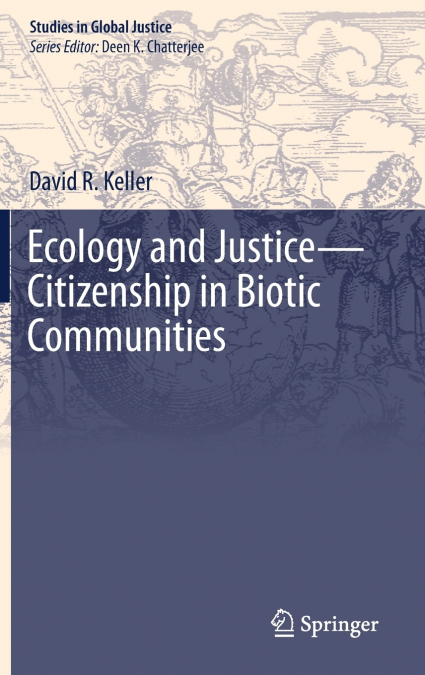
Ecology and Justice-Citizenship in Biotic Communities

Ecology and Justice-Citizenship in Biotic Communities

David R. Keller

120,47 €
IVA incluido
Consulta disponibilidad
Editorial:
Springer Nature B.V.
Año de edición:
2019
Materia
Ética y filosofía moral
ISBN:
9783030116347

Selecciona una librería:

  • Librería Samer Atenea
  • Librería Aciertas (Toledo)
  • Kálamo Books
  • Librería Perelló (Valencia)
  • Librería Elías (Asturias)
  • Donde los libros
  • Librería Kolima (Madrid)
  • Librería Proteo (Málaga)

This is the first book to outline a basic philosophy of ecology using the standard categories of academic philosophy: metaphysics, axiology, epistemology, aesthetics, ethics, and political philosophy. The problems of global justice invariably involve ecological factors. Yet the science of ecology is itself imbued with philosophical questions. Therefore, studies in ecological justice, the sub-discipline of global justice that relates to the interaction of human and natural systems, should be preceded by the study of the philosophy of ecology. This book enables the reader to access a philosophy of ecology and shows how this philosophy is inherently normative and provides tools for securing ecological justice. The moral philosophy of ecology directly addresses the root cause of ecological and environmental injustice:  the violation of fundamental human rights caused by the inequitable distribution of the benefits (economies) and costs (diseconomies) of industrialism. Philosophy of ecology thus has implications for human rights, pollution, poverty, unequal access to resources, sustainability, consumerism, land use, biodiversity, industrialization, energy policy, and other issues of social and global justice. This book offers an historical and interdisciplinary exegesis. The analysis is situated in the context of the Western intellectual tradition, and includes great thinkers in the history of ecological thinking in the West from the natural sciences, social sciences and humanities.​  Keller asks the big questions and surveys answers with remarkable detail.  Here is an insightful analysis of contemporary, classical, and ancient thought, alike in the ecological sciences, the humanities, and economics, the roots and fruits of our concepts of nature and of being in the world.  Keller is unexcelled in bridging the is/ought gap, bridging nature and culture, and in celebrating the richness of life, its pattern, process, and creativity on our wonderland Earth.Holmes Rolston, III University Distinguished Professor, Colorado State UniversityAuthor of A New Environmental Ethics: The Next Millennium for Life on Earth (2012)Mentored by renowned ecologist Frank Golley and renowned philosopher Frederick Ferré, David Keller is well prepared to provide a deep history and a sweeping synthesis of the 'idea of ecology'-including the metaphysical, epistemological, and ethical aspects of that idea, as well as the scientific. J. Baird Callicott University Distinguished Research Professor, University of North TexasAuthor of Thinking Like a Planet: The Land Ethic and the Earth Ethic (2013)

Artículos relacionados

  • Ka Ab Ba Building The Lighted Temple
    Dr Terri R. Nelson / Dr Terri RNelson
    The book KaAbBa Building The Lighted Temple/Metaphysical Keys to the Tree of Life draws a circle that is inclusive of the Afrikan origin of the Ancient Kemetic/Egyptian wisdom. It reveals the undeniable root and link of Ancient Africa to all the religious systems that would develop worldwide. This book is explosive in its power to convey the meaning of KaAbBa, the Medu Neter  (...
    Disponible

    37,41 €

  • Technoethics and the Evolving Knowledge Society
    Rocci Luppicini
    Recently, there has been a major push to rediscover the ethical dimension of technology across the sciences, social sciences, and humanities. Technoethics and the Evolving Knowledge Society: Ethical Issues in Technological Design, Research, Development, and Innovation examines human processes and practices connected to technology embedded within social, political, and moral sph...
  • Kant
    Immanuel Kant
    Kant’s Groundwork of the Metaphysics of Morals is one of the most important works in modern moral philosophy. It belongs beside Plato, Aristotle, Machiavelli, and Hobbes. Here Kant sets out to articulate and defend the Categorical Imperative - the fundamental principle that underlies moral reasoning - and to lay the foundation for a comprehensive account of justice and human vi...
  • On the Duty of Civil Disobedience
    HENRY DAVID THOREAU
    Civil Disobedience argues that citizens should not permit their governments to overrule their consciences, and that they have a duty to avoid allowing their acquiescence to enable the government to make them the agents of injustice. Thoreau was motivated in part by his disgust with slavery and the Mexican-American War, but the sentiments he expresses here are just as pertinent ...
  • Beyond Good and Evil
    Friedrich Nietzsche
    Nietzsche, though primarily a philosopher, wrote widely on art, philology, history, religion, tragedy, culture, and science.  In 1886, at the height of his powers, he published Beyond Good and Evil.  Here he examines much of the best of human thought--dogmatic philosophy, Judeo-Christian morality, science and democracy – and finds it lacking.  Rejecting “slave-morality” he pres...
  • Beyond Good and Evil
    Friedrich Nietzsche
    Nietzsche, though primarily a philosopher, wrote widely on art, philology, history, religion, tragedy, culture, and science.  In 1886, at the height of his powers, he published Beyond Good and Evil.  Here he examines much of the best of human thought--dogmatic philosophy, Judeo-Christian morality, science and democracy – and finds it lacking.  Rejecting “slave-morality” he pres...
    Disponible

    9,99 €