
Inicio > Humanidades > Historia > East Texas Lumber Workers
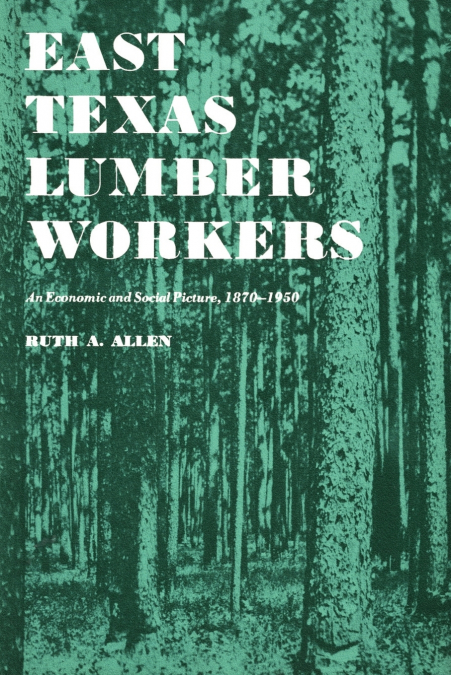
East Texas Lumber Workers

East Texas Lumber Workers

Ruth A. Allen / Ruth AAllen

33,55 €
IVA incluido
Disponible
Editorial:
Univ of Chicago behalf of University of Texas
Año de edición:
2011
Materia
Historia
ISBN:
9780292735903
33,55 €
IVA incluido
Disponible

Selecciona una librería:

  • Librería Samer Atenea
  • Librería Aciertas (Toledo)
  • Kálamo Books
  • Librería Perelló (Valencia)
  • Librería Elías (Asturias)
  • Donde los libros
  • Librería Kolima (Madrid)
  • Librería Proteo (Málaga)

In 1950 a million Texans-more than a tenth of the entire population of the state-lived in a region where one family in every two earned less than $2,000 a year. Composing that region are the thirty-two counties of northeastern Texas in which the lumber industry is concentrated. In eleven of these counties, 70 percent of family incomes were less than $2,000. Until 1930 the Texas lumber industry furnished employment for more workers than any other manufacturing in the state. Though displaced in that year by oil refining, it still ranks near the top in the number of workers it hires. The aim of this study is to show how these people whose economic life has been dominated by a single industry have fared for eighty years in comparison with their fellow Texans and with lumber workers in the Pacific Northwest and the Lakes states. Texas lumber workers have always been in many ways a peculiar people, conditioned by their historical roots, by isolation from the mainstream of national life, and by the deeply rural nature of their environment. A typical group portrait would show two of each three persons to be adult white males. One of three would be African American. It would not show any women. Here and there a face would bear the marks of alien birth. Most of the figures, however, would be natives not only of America but of East Texas. In family background, in work experience, and in social and economic environment these people have been uniquely homogeneous. In the early 1950s the Congressional Committee on the Economic Report of the President designated the area as one of 'deep poverty' and pinpointed it as one which had failed notably to reach the level of living achieved by the state and the nation. Its economic status has been lower than that of any other group in Texas except household servants, and its education level has been well below that of the state and nation and increasingly below the level of acceptance in any jobs other than those requiring a minimum of training and competence. The immediate past has shown not only no improvement but a positive deterioration. Drawing upon personal investigation and state and federal reports, the author has put the contemporary situation in a historical setting. Her delineation is principally in terms of figures that weave a social fabric from which definite patterns emerge-insecure wages, illiteracy and inefficient production, unsuccessful attempts to achieve effective organization. Though the book is directed primarily toward those who should feel concern at its revelations, it also suggests a wealth of untapped sources for the ethnographer and the folklorist.


Artículos relacionados

  • Raising Freedom's Banner
    Paul Harris
    World wide history of peaceful street demonstrations from their earliest beginning in eighteenth century England to their use throughout the world in the twenty-first century. Describes why some demonstration movements succeeded and others failed. Contrasts demonstrations within the law with civil disobedience demonstrations. Describes Peterloo, the Chartists, the Suffragettes,...
    Disponible

    23,59 €

  • Waipi’o Valley
    Jeffrey L. Gross
    Waipi’o Valley: A Polynesian Journey from Eden to Eden recounts the remarkable migrations of the Polynesians across a third of the circumference of the earth. Their amazing journey began from Kalana i Hau’ola, the biblical “Garden of Eden” located along the shore of the Persian Gulf, extended to the Indus River Valley of ancient Vedic India, to Egypt where some ancestors of the...
  • Floralia
    June Rainsford Butler
    A century characterized by a growing interest in science, the opportunity for travel, and leisure for gardening furnishes the setting for Butler’s book. The rise of landscape gardening in England is traced, and the origin and history of its most famous gardens are given. The close relation between England and America in the field of horticulture is also discussed.Originally pub...
    Disponible

    61,20 €

  • President Wilson’s Addresses
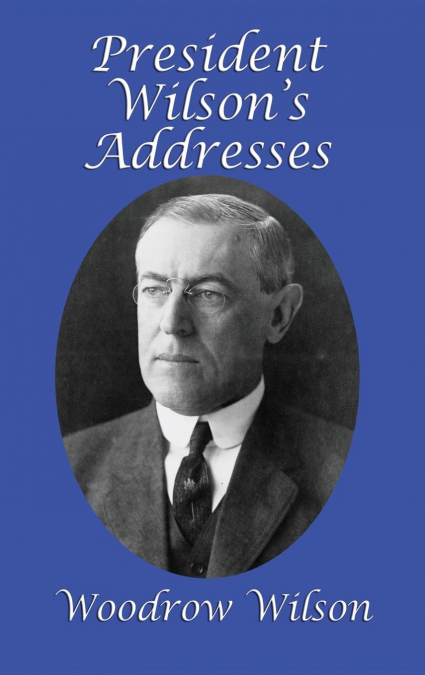
    Woodrow Wilson
    'These addresses of President Woodrow Wilson are almost entirely concerned with political affairs, and more specifically with defining Americanism. Yet they also show that even as he moved from academia to the heights of politics, Wilson retained something of the teacher’s interest in showing the relation between specific instances and the general forms of thought or action of ...
  • The Story of my Life
    John Albert Macy
    The Story of My Life, is Helen Keller’s autobiography detailing her early life, especially her experiences with Anne Sullivan. The book is dedicated to inventor Alexander Graham Bell. The dedication reads, 'To ALEXANDER GRAHAM BELL Who has taught the deaf to speak and enabled the listening ear to hear speech from the Atlantic to the Rockies, I dedicate this Story of My Life.' ...
  • The Story of My Life Vol. 6 Spanish Passions
    Giacomo Casanova
    Casanova was an Italian adventurer and author from the Republic of Venice. His autobiography, Histoire de ma vie (Story of My Life), is regarded as one of the most authentic sources of the customs and norms of European social life during the 18th century. He has become so famous for his often complicated and elaborate affairs with women that his name is now synonymous with 'wom...