

 Librería Samer Atenea
 Kálamo Books
 Librería Elías (Asturias)
 Librería Kolima (Madrid)
 Librería Proteo (Málaga)
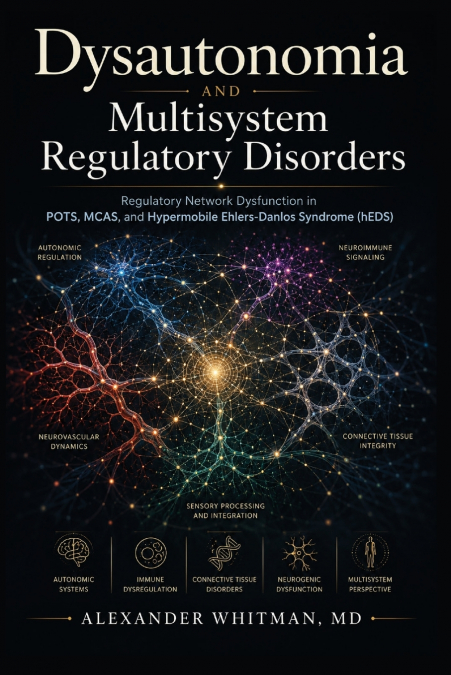
Dysautonomia and Multisystem Regulatory Disorders: Regulatory Network Dysfunction in POTS, MCAS, and Hypermobile Ehlers-Danlos Syndrome (hEDS) examines this clinical challenge through the biology of physiological regulation. It explores how the autonomic nervous system, immune signaling, connective tissue, vascular function, and sensory processing interact and how dysfunction across these systems may contribute to complex, overlapping patterns of chronic illness.The book examines dysautonomia, Postural Orthostatic Tachycardia Syndrome (POTS), Mast Cell Activation Syndrome (MCAS), hypermobile Ehlers-Danlos syndrome (hEDS), small fiber neuropathy, ME/CFS, and Long COVID within a broader framework of regulatory network dysfunction. It connects foundational physiology with clinical assessment, diagnostic reasoning, and therapeutic management without assuming that overlapping symptoms necessarily reflect a single underlying disease.Include:Autonomic regulation, dysautonomia, and orthostatic intolerancePOTS and related hemodynamic disordersMast cell activation and neuroimmune signalinghEDS, hypermobility spectrum disorders, and connective tissue functionSmall fiber neuropathy and sensory dysfunctionME/CFS, Long COVID, and post-infectious illnessMultisystem assessment, clinical phenotyping, and differential diagnosisTreatment principles, rehabilitation, and functional recoveryRegulatory network models and the future of systems-based medicineWritten for physicians, medical students, researchers, and healthcare professionals, this book offers a clinically oriented examination of the mechanisms connecting physiological regulation with multisystem disease.By bringing these interconnected processes into a single framework, Dysautonomia and Multisystem Regulatory Disorders provides a foundation for understanding complex clinical presentations, recognizing patterns across traditional diagnostic boundaries, and approaching patient care with greater physiological and diagnostic precision.





