

Doublet de Boisthibault (François Jules
 Librería Samer Atenea
 Kálamo Books
 Librería Elías (Asturias)
 Librería Kolima (Madrid)
 Librería Proteo (Málaga)
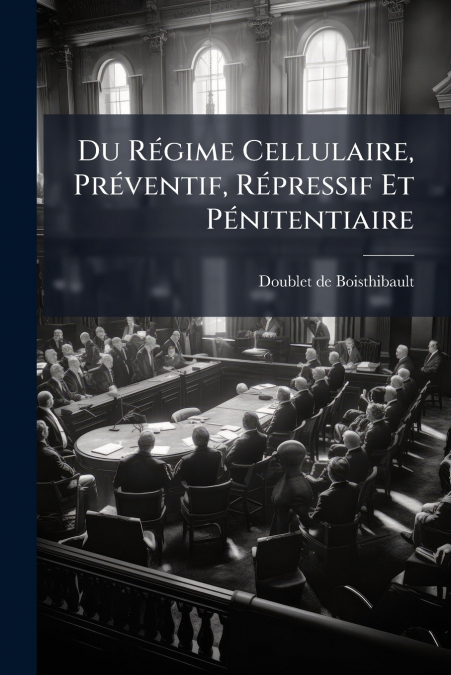
Du Régime Cellulaire, Préventif, Répressif Et Pénitentiaire by Doublet de Boisthibault delves into a proposed cellular system intended to supplant the existing penal system, particularly concerning capital punishment. This historical work, written in French, examines the theoretical and practical implications of a preventative, repressive, and penitentiary structure as an alternative to traditional penal methods. The book offers a detailed exploration of the principles underpinning cellular confinement and its potential impact on crime and punishment. It provides insight into 19th-century perspectives on criminal justice, offering a unique viewpoint on the debate surrounding incarceration and the abolition of the death penalty. 'Du Régime Cellulaire' stands as a valuable historical document for those studying the evolution of criminal law and penological thought, presenting a comprehensive argument for systemic reform within the penal framework.This work has been selected by scholars as being culturally important, and is part of the knowledge base of civilization as we know it. This work was reproduced from the original artifact, and remains as true to the original work as possible. Therefore, you will see the original copyright references, library stamps (as most of these works have been housed in our most important libraries around the world), and other notations in the work.This work is in the public domain in the United States of America, and possibly other nations. Within the United States, you may freely copy and distribute this work, as no entity (individual or corporate) has a copyright on the body of the work.As a reproduction of a historical artifact, this work may contain missing or blurred pages, poor pictures, errant marks, etc. Scholars believe, and we concur, that this work is important enough to be preserved, reproduced, and made generally available to the public. We appreciate your support of the preservation process, and thank you for being an important part of keeping this knowledge alive and relevant.





