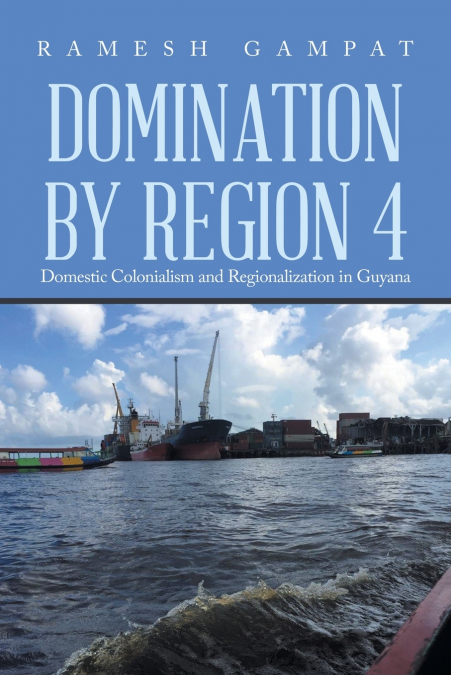

Domination by Region 4

Domination by Region 4

Ramesh Gampat

30,24 €
IVA incluido
Disponible
Editorial:
Xlibris US
Año de edición:
2023
Materia
Economía política
ISBN:
9781669864776
30,24 €
IVA incluido
Disponible

Selecciona una librería:

  • Librería Samer Atenea
  • Kálamo Books
  • Librería Elías (Asturias)
  • Librería Kolima (Madrid)
  • Librería Proteo (Málaga)

This book argues that Guyana presently operates a system of domestic colonialism (DM). DM builds on institutions established during imperial colonialism, strengthened and expanded since independence in 1966, and regionalization, which balkanized the country into ten administrative regions. Regionalization is a flexible instrument that enables political and economic control, with one strengthening the other, further empowering Region 4 where the 'metropole' is located, and enhancing the dependency of the nine satellite regions. Both political parties exploits regionalization when in power, the PPP principally through financial strangulation and discrimination, the PNC and its various incarnations via political control. Regionalization is the symbol of domestic colonialism.PPP-I (last six years of its previous regime, 2009 to 2014) allocated an annual average of 11.1 percent of public funds to the regions, the APNU+AFC 14.1 percent from 2015 to 2020, and PPP-II, the current PPP administration, 12.5 percent during its first two years in office. Over the fourteen-years from 2009 to 2022, the four largest agencies consumed 42.5 percent of total Central Government expenditure. Under PPP-I, these agencies spent 15 percentage points more on capital costs than they did under APNU+AFC. However, under the latter government they spent more than 10 percentage points on the amorphous category 'Other Charges.' These anomalies are hard to explain because there were no functional enhancements or reach of coverage by these agencies. Incredibly, the Ministry of Finance (MoF), the largest agency for all but one year, spent 46.1 percent of what the Ministry of Public Works incurred on public infrastructure for the entire country. An important avenue of political patronage is the employment of contract and temporary workers, who are hired outside of the public service legislative framework. These workers comprised half of the MoF’s workforce over the fourteen-year period and the last six years of PPP-I; for the Ministry of Health, that figure is around 37.0 percent for both periods. Employment patronage rose during APNU+AFC’s term of office, to 53.8 percent in the MoF and to 41.8 percent in the MoH. Employment patronage at these two big agencies was lower during PPP-I than the six years of the APNU+AFC Government.'Patronage employment' is considerably lower with the PPP-II than all previous regimes. The strategic deviation is explained by the rise of three separate categories of low- and unskilled workers, who account for 48.5 percent and 57.7 percent of workforce of the MoF and the MoH, respectively. These figures are more than 10 percentage points larger than those of all previous administrations. In effect, the PPP doles out patronage away from hiring outside of the public service legislative framework to hiring within it. Not only has the PPP 'legalized' patronage, it has also increased it significantly.


Artículos relacionados

  • Private Affluence and Public Squalor
    Paul L L Nevins / Paul L Nevins
    Are the values that Americans collectively hold destroying the American Dream? The answer to that question depends upon the answers to some very specific questions. What do we as citizens of the United States believe we owe to one another as citizens? What is the purpose of government? What is of the role of the private enterprise? What is the meaning of equal opportunity? To w...
    Disponible

    24,04 €

  • Of Privacy and Power
    Abraham L. Newman / Henry Farrell
    How disputes over privacy and security have shaped the relationship between the European Union and the United States and what this means for the futureWe live in an interconnected world, where security problems like terrorism are spilling across borders, and globalized data networks and e-commerce platforms are reshaping the world economy. This means that states’ jurisdictions ...
    Disponible

    29,73 €

  • Migration and Democracy
    Abel Escribà-Folch / Covadonga Meseguer / Joseph Wright
    How remittances-money sent by workers back to their home countries-support democratic expansionIn the growing body of work on democracy, little attention has been paid to its links with migration. Migration and Democracy focuses on the effects of worker remittances-money sent by migrants back to their home countries-and how these resources shape political action in the Global S...
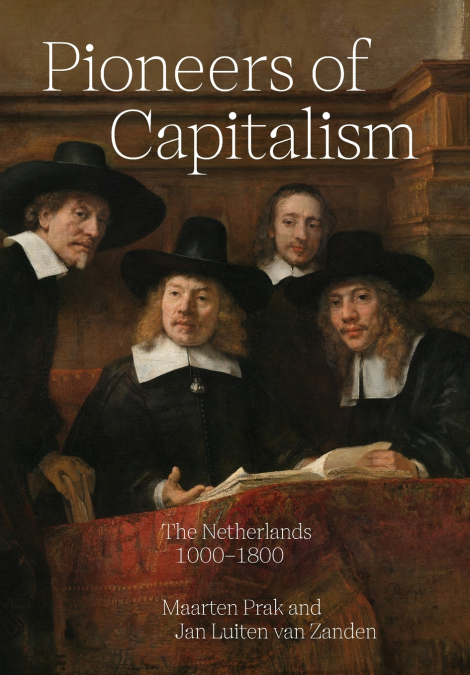
  • Pioneers of Capitalism
    Jan Luiten van Zanden / Maarten Prak / Ian Cressie
    How medieval Dutch society laid the foundations for modern capitalismThe Netherlands was one of the pioneers of capitalism in the Middle Ages, giving rise to the spectacular Dutch Golden Age while ushering in an era of unprecedented, long-term economic growth. Pioneers of Capitalism examines the formal and informal institutions in the Netherlands that made this economic miracle...
  • Pillars of Prosperity
    Timothy Besley / Torsten Persson
    How nations can promote peace, prosperity, and stability through cohesive political institutions'Little else is required to carry a state to the highest degree of opulence from the lowest barbarism, but peace, easy taxes, and a tolerable administration of justice; all the rest being brought about by the natural course of things.' So wrote Adam Smith a quarter of a millennium ag...
    Disponible

    66,08 €

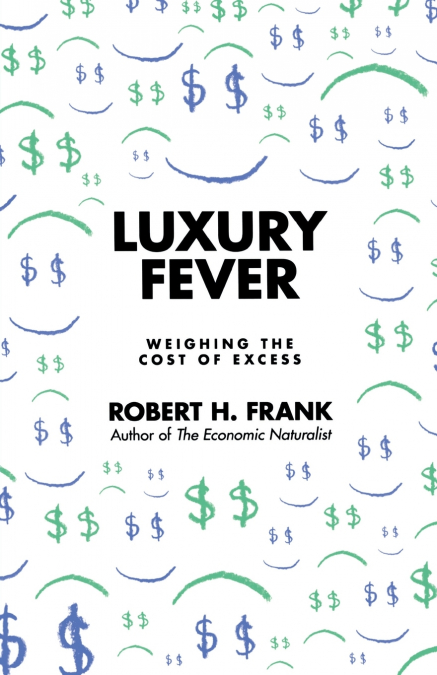
  • Luxury Fever
    Robert H. Frank
    The turn of the twenty-first century witnessed a spectacular rise in gross consumption. With the super-rich setting the pace, everyone spent furiously in a desperate attempt to keep up. As cars and houses grew larger and more expensive, the costs were enormous--not only monetarily but also socially. Consumers spent more time at work and less time with their family and friends; ...
    Disponible

    35,51 €

Otros libros del autor

  • The Guyanese FX Market Modern Discourses and Controversies
    Ramesh Gampat
    Ramesh Gampat stands out as the first analyst to consolidate recent statistics on Guyana’s burgeoning oil economy. His work is essential reading for anyone engaged in public debate and policy regarding the dynamics of the local foreign exchange market, fiscal and public debt policies, and exchange rate management. Students and general readers will appreciate the accessible intr...
    Disponible

    35,92 €

  • Essays
    Ramesh Gampat
    There is no information available at this point. ...
    Disponible

    30,11 €

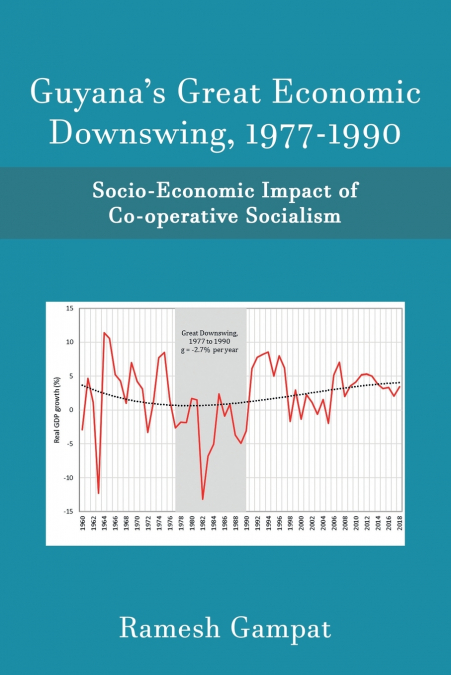
  • Guyana’s Great Economic Downswing, 1977-1990
    Ramesh Gampat
    Much of Guyana’s 20th century history was defined by the PNC dictatorship and the political and economic wreckage it left behind. In 'Guyana’s Great Economic Downswing, 1977 to 1990', Dr Ramesh Gampat presents a comprehensive study of these specific years when the national economy contracted by 2.7 percent annually. He explores the multiple facets of the country’s political tri...
    Disponible

    37,41 €

  • Sanatana Dharma and Plantation Hinduism (Second Edition Volume 2)
    Ramesh Gampat
    Christian Missionaries worked hard to convert immigrants. Their first order of business was to denigrate Hinduism, designate Hindus as heathen, and disparage their culture, food and even attire. Immigrants stubbornly resisted, led by the tiny educated elite, including Brhmaas whom we call Brahmins. Conversion was a failure at least up to the end of the 19th century but picked...
    Disponible

    14,06 €

  • Sanatana Dharma and Plantation Hinduism (Second Edition Volume 1)
    Ramesh Gampat
    Christian Missionaries worked hard to convert immigrants. Their first order of business was to denigrate Hinduism, designate Hindus as heathen, and disparage their culture, food and even attire. Immigrants stubbornly resisted, led by the tiny educated elite, including Brhmaas whom we call Brahmins. Conversion was a failure at least up to the end of the 19th century but picked...
    Disponible

    17,43 €

  • Sanatana Dharma and Plantation Hinduism
    Ramesh Gampat
    The share of Hindus in Guyana’s Indian population declined from 83.5 percent in 1880 to 62.8 percent in 2012. Yet even a casual observer would conclude that Guyanese Hindus, at home and in the diaspora, are a very religious people. Many of us do a jhandi or havan once annually; others do the more elaborate and costlier yajña, where everyone is welcome, once or twice in their li...
    Disponible

    26,67 €