 Librería Samer Atenea
 Kálamo Books
 Librería Elías (Asturias)
 Librería Kolima (Madrid)
 Librería Proteo (Málaga)
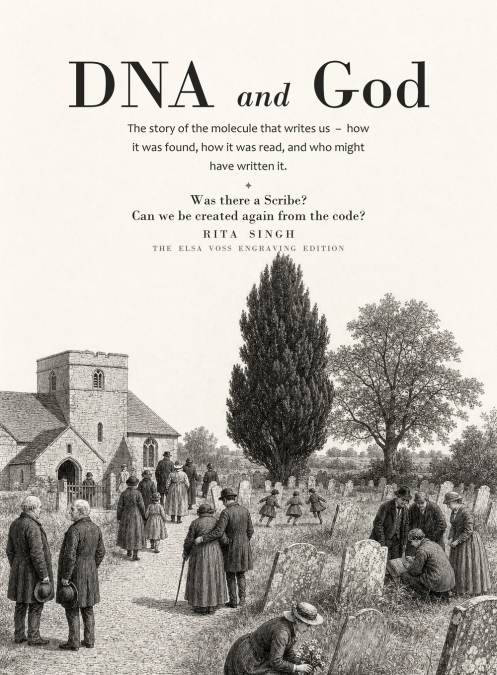
DNA and God · Rita Singh · The Elsa Voss Engraving Edition Every living thing is written. Inside each cell lies a book of instructions for a life - in a language with an alphabet of just four letters and a dictionary of billions of words. DNA and God is the story of how that book was found, how we learned to read it, and what we saw when we did. It is a graphic novel told almost entirely in pictures: more than five hundred full-page plates, one to a page, each drawn in the manner of a nineteenth-century steel engraving - pure line and fine hatching, the work of the engraver Elsa Voss. Beneath each plate sit a few plain sentences; there are no chapters of running prose. The book reads the way a Victorian scientific atlas reads - you turn the pages, and the story is in what you see. It begins in 1869, when a young Swiss physician washes cells from discarded surgical bandages and finds a grey substance no one has named. From there it follows the eighty-four-year relay to the double helix - the four letters, a beautiful mistake that hid the truth for decades, a single photograph carried across London, Rosalind Franklin, and at last the shape itself and the cracking of the code. Then it turns to harder questions: how a molecule with no mind chooses its partners so exactly, where the first copy came from, and how - with CRISPR - we have learned to write in the code ourselves, and crossed a line we had ever faced. Across 145 sections, in four parts and an interlude, the evidence is laid out rung by rung, from bare atoms to a living thing that copies itself. It points one way: that no one wrote it - that time, chance, and the Earth’s countless experiments composed the book themselves, across billions of years. And yet it reads like writing. A code, a language, a text that spells out a living thing - and everything ever written has had a writer. Was there a Scribe? Can we be created again from the code? The book does not pretend to know. It lays the evidence out, and lets you weigh chance against design for yourself. For anyone who has lost someone, and wondered whether they could come back.