

Inicio > > Programación informática/desarrollo de software > Distributed Formation Algorithms for Autonomous Robots
Distributed Formation Algorithms for Autonomous Robots

Distributed Formation Algorithms for Autonomous Robots

Vadimir Mikong

24,68 €
IVA incluido
Disponible
Editorial:
SHARK NAIL
Año de edición:
2026
Materia
Programación informática/desarrollo de software
ISBN:
9781962116848
24,68 €
IVA incluido
Disponible

Selecciona una librería:

  • Librería Samer Atenea

  • Kálamo Books
  • Librería Elías (Asturias)
  • Librería Kolima (Madrid)
  • Librería Proteo (Málaga)

Distributed robotic systems have become a cornerstone of modern automation, enabling multiple autonomous robots to collaborate efficiently without relying on centralized control. Distributed Formation Algorithms for Autonomous Robots provides a comprehensive introduction to the principles, algorithms, and engineering concepts that enable teams of autonomous robots to organize, coordinate, and maintain cooperative formations while operating in dynamic and uncertain environments. By combining robotics, distributed computing, artificial intelligence, control engineering, and autonomous navigation, the book presents the foundational technologies that support coordinated multi-robot systems across a wide range of applications.The book explores the architecture of distributed robotic systems by examining how autonomous robots communicate, exchange information, and make decentralized decisions while accomplishing shared objectives. Readers are introduced to the concepts of distributed control, cooperative behavior, multi-agent systems, communication networks, consensus algorithms, and autonomous coordination that enable robot teams to function effectively without continuous centralized supervision. The discussion emphasizes scalability, fault tolerance, adaptability, and reliability as essential characteristics of distributed robotic architectures.A central focus is placed on formation algorithms that allow autonomous robots to establish, maintain, and modify geometric formations while responding to environmental changes. The text examines the engineering principles behind formation control, leader-follower strategies, consensus-based coordination, behavior-based methods, graph-theoretic approaches, and decentralized navigation. It also discusses motion planning, obstacle avoidance, trajectory generation, localization, and synchronization techniques that contribute to safe and efficient collaborative robot operation. These topics provide readers with a practical understanding of how distributed algorithms improve coordination, flexibility, and operational performance within multi-robot environments.The book further explores sensing, perception, and communication technologies that support distributed robotic intelligence. Topics including sensor fusion, environmental mapping, simultaneous localization and mapping (SLAM), wireless communication, cooperative perception, path planning, autonomous decision-making, and real-time coordination are presented within the broader framework of intelligent robotic systems. Readers gain insight into how distributed robotic platforms can share information, adapt to changing conditions, and accomplish complex tasks through coordinated action while minimizing computational and communication overhead.

Artículos relacionados

  • SPARK 2014 Reference Manual
    AdaCore / Altran UK Ltd
    SPARK 2014 is a programming language and a set of verification tools designed to meet the needs of high-assurance software development. SPARK 2014 is based on Ada 2012, both subsetting the language to remove features that defy verification, but also extending the system of contracts and aspects to support modular, formal verification.This manual is available online for free at ...
    Disponible

    19,91 €

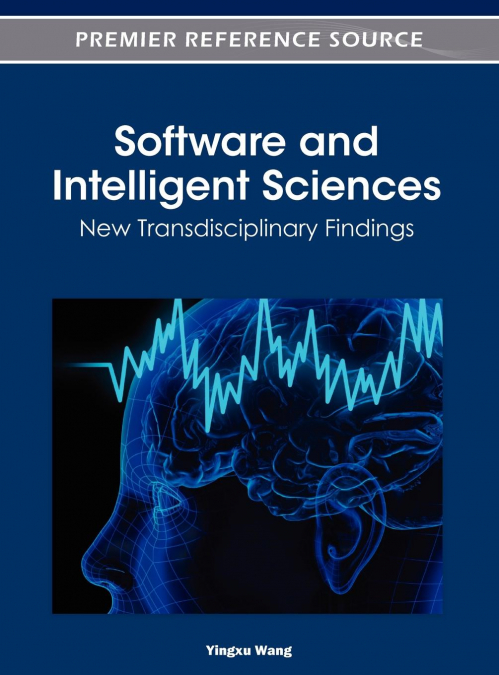
  • Software and Intelligent Sciences
    Yingxu Wang
    The junction of software development and engineering combined with the study of intelligence has created a bustling intersection of theory, design, engineering, and conceptual thought. Software and Intelligent Sciences: New Transdisciplinary Findings sits at a crossroads and informs advanced researchers, students, and practitioners on the developments in computer science, theor...
  • Power System Planning Technologies and Applications
    Fawwaz Elkarmi / Nazih Abu Shikhah / Nazih Abu-Shikhah
    Planning is an important function of the management of any business, providing knowledge of future prospects and enabling prudent and appropriate decision-making. Planning is especially critical for power systems, since electricity is a fundamental part of modern societies and many conventional electrical energy resources currently in use are limited. Power System Planning Tech...
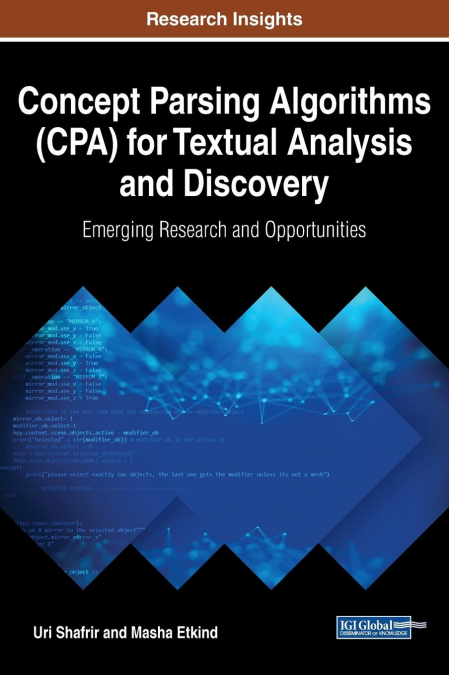
  • Concept Parsing Algorithms (CPA) for Textual Analysis and Discovery
    Masha Etkind / Uri Shafrir
    Text analysis tools aid in extracting meaning from digital content. As digital text becomes more and more complex, new techniques are needed to understand conceptual structure. Concept Parsing Algorithms (CPA) for Textual Analysis and Discovery: Emerging Research and Opportunities provides an innovative perspective on the application of algorithmic tools to study unstructured d...
  • Model-Based Design for Effective Control System Development
    Wei Wu
    Control systems are an integral aspect of modern society and exist across numerous domains and applications. As technology advances more and more, the complexity of such systems continues to increase exponentially. Model-Based Design for Effective Control System Development is a critical source of scholarly information on model-centric approaches and implementations for control...
  • Verification, Validation and Testing in Software Engineering
    ...