Fermín Arana de Varflora / Imprenta de Marina. fl. 1798 / Imprenta de Marinafl1798 / Manuel Quintana y Compañía. fl. 1798 / Manuel Quintana y Compañíafl1798
 Librería Samer Atenea
 Kálamo Books
 Librería Elías (Asturias)
 Librería Kolima (Madrid)
 Librería Proteo (Málaga)
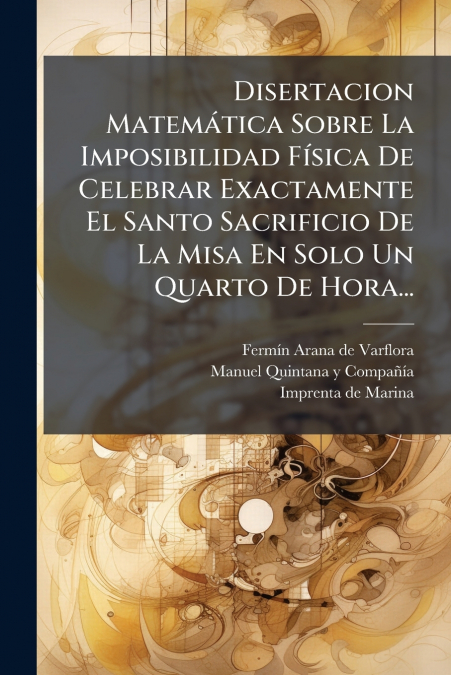
Disertacion Matemática Sobre La Imposibilidad Física De Celebrar Exactamente El Santo Sacrificio De La Misa En Solo Un Quarto De Hora... is a historical mathematical treatise concerning the physical impossibility of celebrating the Holy Sacrifice of the Mass in just fifteen minutes. Penned by Fermín Arana de Varflora, with printing by Manuel Quintana y Compañía and Imprenta de Marina in 1798, this work delves into the intersection of mathematics and religious practice within the Catholic tradition.This book offers a unique perspective on the application of mathematical principles to a theological question, providing insight into the intellectual landscape of the late 18th century. Scholars of mathematics, religious history, and the history of science will find this work to be a fascinating example of the era’s attempts to reconcile faith and reason.This work has been selected by scholars as being culturally important, and is part of the knowledge base of civilization as we know it. This work was reproduced from the original artifact, and remains as true to the original work as possible. Therefore, you will see the original copyright references, library stamps (as most of these works have been housed in our most important libraries around the world), and other notations in the work.This work is in the public domain in the United States of America, and possibly other nations. Within the United States, you may freely copy and distribute this work, as no entity (individual or corporate) has a copyright on the body of the work.As a reproduction of a historical artifact, this work may contain missing or blurred pages, poor pictures, errant marks, etc. Scholars believe, and we concur, that this work is important enough to be preserved, reproduced, and made generally available to the public. We appreciate your support of the preservation process, and thank you for being an important part of keeping this knowledge alive and relevant.