Discrimination and Delegation

Discrimination and Delegation

Lamis Elmy Abdelaaty

128,18 €
IVA incluido
Consulta disponibilidad
Editorial:
Oxford University Press
Año de edición:
2021
Materia
Relaciones internacionales
ISBN:
9780197530061

Selecciona una librería:

  • Librería Samer Atenea
  • Librería Aciertas (Toledo)
  • Kálamo Books
  • Librería Perelló (Valencia)
  • Librería Elías (Asturias)
  • Donde los libros
  • Librería Kolima (Madrid)
  • Librería Proteo (Málaga)

What explains the variety of responses that states adopt toward different refugee groups? Refugees might be granted protection or turned away; they might be permitted to live where they wish and earn an income, pursue education, and access medical treatment; or, they might be confined to a camp and forced to rely on aid while being denied basic services. However, states do not consistently wield their capacity for control, nor do they jealously guard their authority to regulate. In this book, Lamis Elmy Abdelaaty asks why states sometimes assert their sovereignty vis-�-vis refugee rights and at other times seemingly cede it by delegating refugee oversight to the United Nations. To explain this selective exercise of sovereignty, Abdelaaty develops a two-part theoretical framework in which policymakers in refugee-receiving countries weigh international and domestic concerns. Policymakers in a receiving country might decide to offer protection to refugees from a rival country in order to undermine the sending country’s stability, saddle it with reputation costs, and even engage in guerilla-style cross-border attacks. At the domestic level, policymakers consider political competition among ethnic groups--welcoming refugees who are ethnic kin of citizens can satisfy domestic constituencies, expand the base of support for the government, and encourage mobilization along ethnic lines. When these international and domestic incentives conflict, the state shifts responsibility for refugees to the UN, which allows policymakers to placate both refugee-sending countries and domestic constituencies. Abdelaaty analyzes asylum admissions worldwide, and then examines three case studies in-depth: Egypt (a country that is broadly representative of most refugee recipients), Turkey (an outlier that has limited the geographic application of the Refugee Convention), and Kenya (home to one of the largest refugee populations in the world). Discrimination and Delegation argues that foreign policy and ethnic identity, more so than resources, humanitarianism, or labor skills, shape reactions to refugees.
Artículos relacionados

  • Realism in Practice
    The purpose of this book is to appraise the current relevance and validity of realism as an interpretative tool in contemporary International Relations. All chapters of the book are animated by a theoretical effort to define the conceptual aspects of realism and attempt to establish whether the tradition still provides the necessary conceptual tools to scholars.The chapters add...
    Disponible

    20,36 €

  • Predicting gender violence in India
    Shritha K Vasudevan
    In this provocative new book, Shritha Vasudevan argues that feminist international relations (IR) theory has inadvertently resulted in a biased worldview, the very opposite of what feminist IR set out to try to rectify. This book contests theoretical presumptions of Western feminist IR and attempts to reformulate it in contexts of non-Western cultures. Vasudevan deftly utilizes...
  • Contemporary security issues in Africa
    Isiaka Alani Badmus / Lere Amusan
    In volume, an emerging generation of African scholars examines specific states in Africa where instability is the order of the day. Considerations of African instability are highly relevant in today’s world, where one examines the types of regimes that were put in place after the Cold War and their effects on Africa. Multiparty systems introduced in Africa, rather than bringing...
  • Chronicles of the first and second chechen wars
    Ilya Milyukov
    Presented by Russian author and attorney Ilya Milyukov, Chronicles of the First and Second Chechen War presents the main events of the First (1994-1996) and Second (1999-2009) Wars in Chechnya, Russia’s deadliest conflicts since World War II. The First War began in December 1994 and lasted for one year and nine months, ending in August 1996. There were two major urban battles -...
  • Political instability in Africa
    Isiaka Alani Badmus / Lere Amusan
    This book offers broad-gauged analyses of the causes, nature, and changing patterns of armed conflict in Africa as well as the reasons for these patterns. It also situates conflicts that have been haunting the African continent since the time of decolonization within the various theoretical schools such as 'new war,' 'economic war,' 'neo-patrimonial,' and 'globalization.' It be...
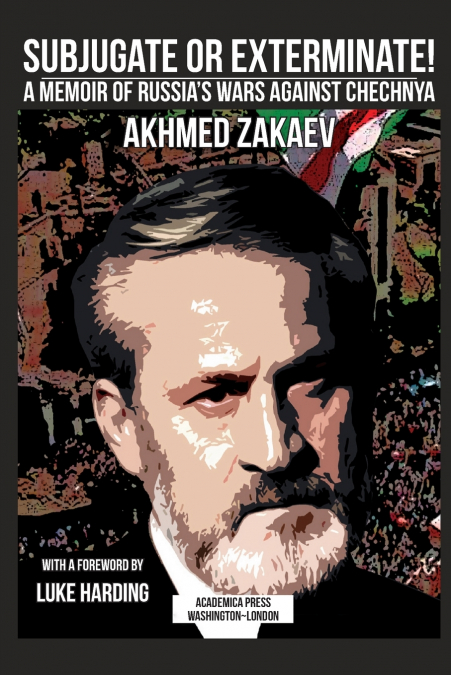
  • Subjugate or exterminate!
    Akhmed Zakaev / Arch Tait
    Foreword by Luke HardingAkhmed Zakaev is a symbol of the indomitable will of the Chechen nation. In this important memoir, he tells the story of the Chechen struggle as he experienced it, describing the conflict in human terms and providing a detailed documentary record of little known or badly understood events that will be of benefit to historians for generations to come.- Da...
    Disponible

    41,63 €