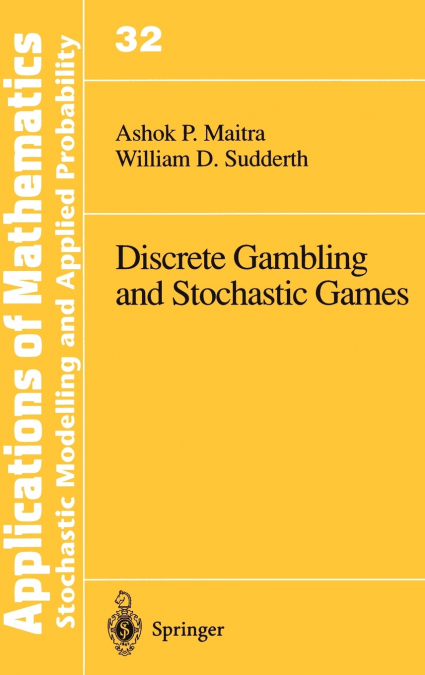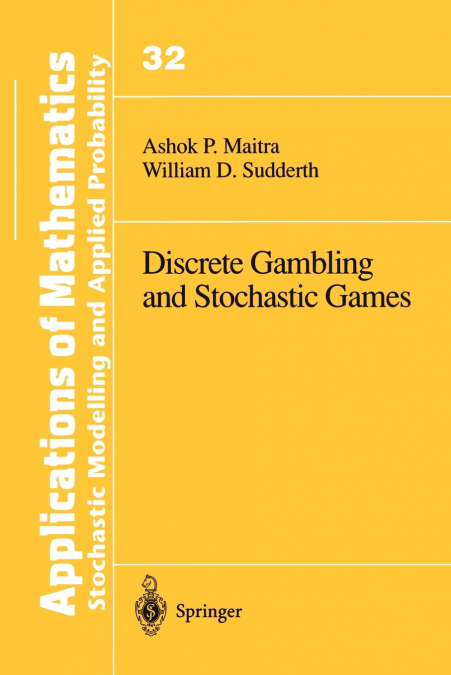
Discrete Gambling and Stochastic Games

Discrete Gambling and Stochastic Games

Ashok P. Maitra / William Sudderth

134,07 €
IVA incluido
Disponible
Editorial:
Springer Nature B.V.
Año de edición:
2011
Materia
Probabilidad y estadística
ISBN:
9781461284673
134,07 €
IVA incluido
Disponible

Selecciona una librería:

  • Librería Samer Atenea
  • Librería Aciertas (Toledo)
  • Kálamo Books
  • Librería Perelló (Valencia)
  • Librería Elías (Asturias)
  • Donde los libros
  • Librería Kolima (Madrid)
  • Librería Proteo (Málaga)

The theory of probability began in the seventeenth century with attempts to calculate the odds of winning in certain games of chance. However, it was not until the middle of the twentieth century that mathematicians de­ veloped general techniques for maximizing the chances of beating a casino or winning against an intelligent opponent. These methods of finding op­ timal strategies for a player are at the heart of the modern theories of stochastic control and stochastic games. There are numerous applications to engineering and the social sciences, but the liveliest intuition still comes from gambling. The now classic work How to Gamble If You Must: Inequalities for Stochastic Processes by Dubins and Savage (1965) uses gambling termi­ nology and examples to develop an elegant, deep, and quite general theory of discrete-time stochastic control. A gambler 'controls' the stochastic pro­ cess of his or her successive fortunes by choosing which games to play and what bets to make.

Artículos relacionados

  • ENGINEERING UNCERTAINTY AND RISK ANALYSIS
    Sergio E. Serrano
    An integrated coverage of probability, statistics, Monte Carlo simulation, inferential statistics, design of experiments, systems reliability, fitting random data to models, analysis of variance, stochastic processes, and stochastic differential equations for engineers and scientists. The author for first time presents an introduction to the broad field of applied engineering u...
    Disponible

    134,56 €

  • UNDERSTANDING AND CALCULATING THE ODDS
    Catalin Barboianu
    Man’s daily life is full of decisional situations. Whether we have math skills or not, we frequently estimate and compare probabilities, sometimes without realizing it, especially when making decisions. But probabilities are not just simple numbers attached objectively or subjectively to events, as they perhaps look, and their calculus and usage is highly predisposed to qualita...
    Disponible

    31,61 €

  • Random Graphs and Complex Networks
    Remco van der Hofstad
    ...
  • Introduction to Malliavin Calculus
    David Nualart / Eulalia Nualart
    ...
    Disponible

    60,35 €

  • Probability, Markov Chains, Queues, and Simulation
    William J. Stewart
    Probability, Markov Chains, Queues, and Simulation provides a modern and authoritative treatment of the mathematical processes that underlie performance modeling. The detailed explanations of mathematical derivations and numerous illustrative examples make this textbook readily accessible to graduate and advanced undergraduate students taking courses in which stochastic process...
  • SPSS for you
    A. Rajathi / P. Chandran
    In an era where statistical analysis underpins breakthroughs across all fields, the importance of mastering statistical software cannot be overstated. 'SPSS for you' emerges as a pivotal resource for anyone keen to navigate the complexities of statistical analysis with ease and precision. Drawing from over 25 years of teaching experience, practical guidance in statistical analy...
    Disponible

    29,30 €

Otros libros del autor

  • Discrete Gambling and Stochastic Games
    Ashok P. Maitra / William Sudderth
    The theory of probability began in the seventeenth century with attempts to calculate the odds of winning in certain games of chance. However, it was not until the middle of the twentieth century that mathematicians de­ veloped general techniques for maximizing the chances of beating a casino or winning against an intelligent opponent. These methods o...