Disagreement

Disagreement

Jacques Ranciere

43,07 €
IVA incluido
Disponible
Editorial:
Univ of Chicago behalf of Minnesota Univ Pres
Año de edición:
2004
Materia
Filosofía
ISBN:
9780816628452
43,07 €
IVA incluido
Disponible

Selecciona una librería:

  • Librería Samer Atenea
  • Librería Aciertas (Toledo)
  • Kálamo Books
  • Librería Perelló (Valencia)
  • Librería Elías (Asturias)
  • Donde los libros
  • Librería Kolima (Madrid)
  • Librería Proteo (Málaga)

'Is there any such thing as political philosophy?' So begins this provocative book by one of the foremost figures in Continental thought. Here, Jacques Rancière brings a new and highly useful set of terms to the vexed debate about political effectiveness and 'the end of politics.' What precisely is at stake in the relationship between 'philosophy' and the adjective 'political'? In Disagreement, Rancière explores the apparent contradiction between these terms and reveals the uneasy meaning of their union in the phrase 'political philosophy'-a juncture related to age-old attempts in philosophy to answer Plato’s devaluing of politics as a 'democratic egalitarian' process. According to Rancière, the phrase also expresses the paradox of politics itself: the absence of a proper foundation. Politics, he argues, begins when the 'demos' (the 'excessive' or unrepresented part of society) seeks to disrupt the order of domination and distribution of goods 'naturalized' by police and legal institutions. In addition, the notion of 'equality' operates as a game of contestation that constantly substitutes litigation for political action and community. This game, Rancière maintains, operates by a primary logic of 'misunderstanding.' In turn, political philosophy has always tried to substitute the 'politics of truth' for the politics of appearances. Disagreement investigates the various transformations of this regime of 'truth' and their effects on practical politics. Rancière then distinguishes what we mean by 'democracy' from the practices of a consensual system in order to unravel the ramifications of the fashionable phrase 'the end of politics.' His conclusions will be of interest to readers concerned with political questions from the broadest to the most specific and local.
Artículos relacionados

  • Introduction to a Future Way of Thought
    Kostas Axelos / Kenneth Mills
    'Technologists only change the world in various ways in generalized indifference; the point is to think the world and interpret the changes in its unfathomability, to perceive and experience the difference binding being to the nothing.'Anticipating the age of planetary technology Kostas Axelos, a Greek-French philosopher, approaches the technological question in this book, firs...
    Disponible

    18,58 €

  • Capsule
    John Kenneth Press
    Join John and Adam as they wander the mean streets of Japan on a psychedelic fueled search for identity. While fun for the average reader, this book could also serve as a philosphy textbook because of its ordered exploration of sources of identity. Ultimately this trip through nationalist attacks, sex, and drugs, will take you to a better understanding of yourself and your pl...
    Disponible

    11,51 €

  • If you look at it long enough...
    Paul Hallam
    Originally written for an academic journal, If you look at it long enough... is primarily a personal account of Paul Hallam’s recollections of “self-abuse” through the consumption of porn over several decades. Challenging the familiar form of an “academic essay,” this autobiographical narrative raises several questions in relation to our contemporary morals related to sex in ge...
    Disponible

    11,30 €

  • The Teachers of Gurdjieff
    Rafael Lafort / Rafael Lefort
    When The Teachers of Gurdjieff was first published more than 50 years ago, it made a considerable stir. George Ivanovich Gurdjieff had been one of the most famous mystics in the West in the first half of the 20th century - a teaching master who had many fashionable and influential pupils. He had a striking appearance and manner of teaching, and his teaching proved to be very in...
    Disponible

    20,45 €

  • Manifesto of the Communist Party
    Karl Marx
    The Communist Manifesto was first published on February 21, and it is one of the world’s most influential political tracts. Commissioned by the Communist League and written by communist theorists Karl Marx and Friedrich Engels, it laid out the League’s purposes and program. The Manifesto suggested a course of action for a proletarian (working class) revolution to overthrow the ...
  • The Art of Literature
    Arthur Schopenhauer
    Collected here are eight short essays, On Authorship, On Style, On the Study of Latin, On Men of Learning, On Thinking for Ones Self, On Criticism, On Reputation, On Genius, by the world renowned philosopher Arthur Achopenhauer. ...

Otros libros del autor

  • Althusser’s Lesson
    Jacques Ranciere
    Jacques Rancière’s first major work, Althusser’s Lesson appeared in 1974, just as the energies of May 68 were losing ground to the calls for a return to order. Rancière’s analysis of Althusserian Marxism unfolds against this background: what is the relationship between the return to order and the enthusiasm which greeted the publication of Althusser’s Reply to John Lewis in 197...
    Disponible

    34,21 €

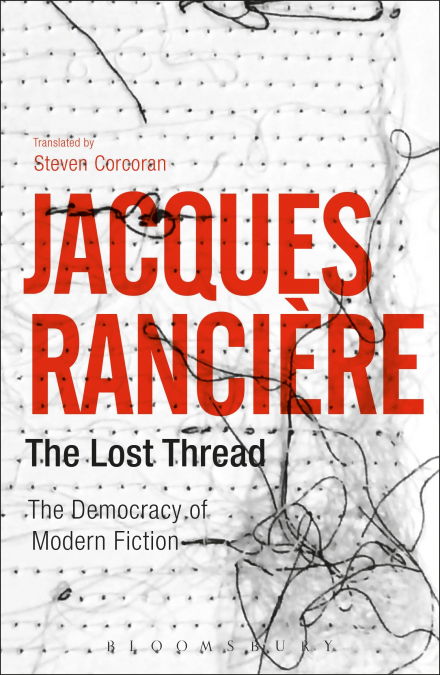
  • The Lost Thread
    Jacques Rancière
    In The Lost Thread, Rancière debunks the notion of Flaubert, Baudelaire, Conrad, Woolf and Keats as reactionary producers of bourgeois mythologies, and instead foregrounds the egalitarian and democratic impulses of modernist literature. Contrary to the canonical interpretation of the relation between modernism and capitalism via the commodification of everyday life, Rancière p...
    Disponible

    39,57 €

  • Chronicles of Consensual Times
    Jacques Ranciere
    In this fascinating collection, Jacques Ranciere, one of the world’s most important and influential living philosophers, explores the nature of consensus in contemporary politics. Consensus does not mean peace. Instead it refers to a map of operations of war, of a topography of the visible, of what is possible and what can be thought, in which war and peace live side-by-side. L...
  • The Philosopher and His Poor
    Jacques Rancière
    What has philosophy to do with the poor? If, as has often been supposed, the poor have no time for philosophy, then why have philosophers always made time for them? Why is the history of philosophy-from Plato to Karl Marx to Jean-Paul Sartre to Pierre Bourdieu-the history of so many figures of the poor: plebes, men of iron, the demos, artisans, common people, proletarians, the ...
    Disponible

    35,45 €