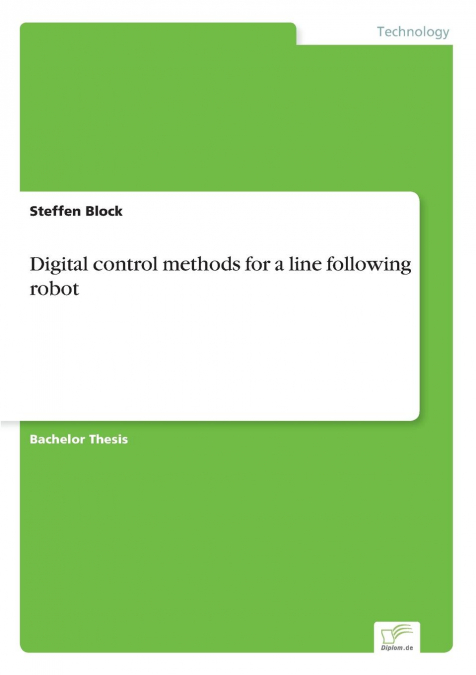

Digital control methods for a line following robot

Digital control methods for a line following robot

Digital control methods for a line following robot

Steffen Block

89,33 €
IVA incluido
Disponible
Editorial:
diplom.de
Año de edición:
2003
ISBN:
9783838675121
89,33 €
IVA incluido
Disponible

Selecciona una librería:

  • Librería Samer Atenea
  • Librería Aciertas (Toledo)
  • Kálamo Books
  • Librería Perelló (Valencia)
  • Librería Elías (Asturias)
  • Donde los libros
  • Librería Kolima (Madrid)
  • Librería Proteo (Málaga)

Inhaltsangabe:Abstract: The project aim was to a built a robot, controlled by a PIC microcontroller to follow a line completely autonomously and as quickly as possible. The robot meets the requirements from the „RoboRama Contest”, followed a T-shape course, and obtained more (safety) features. Different kinds of design features and digital algorithms were developed and tested, in order to achieve the best results. Applied project management techniques and used key skills, guaranteed the successful completion of the project, in the design and construction of hardware and software technologies. The hardware was based on a block structure with infrared sensors at the front of the vehicle. Their analogue signals were transferred to digital logic with a comparator. This information used a PIC 16F84A microcontroller to control the movement and direction of the robot with pulse width modulation (PWM). All parts were mounted on a chassis, implemented with a mechanical construction set. Batteries of 9V provided the necessary power supply. Adjustments were done through iterative steps, to come to the final result of the robot system. The main adapted design feature was the motor and steering system. First of all a separate servomotor for the steering and a single DC motor for the forward movement was fixed. Through implemented and first testing steps, this resolution lacked the required performance. Hence, the design changed to two DC motors, which offered a satisfactory solution. The electronic circuit was designed with the computer aided design tool Proteus and executed as a strip line board. The software algorithm development started with the truth table to reduce the possible events from thirty-two to the eleven applied conditions. The generated flowchart gave the program a structure and applied the truth table decision in different PWM generations. Finally, the software was written in assembler language and implemented on the PIC. Inhaltsverzeichnis:Table of
Artículos relacionados

  • Video Surveillance Techniques and Technologies
    Vesna Zeljkovic
    Security video surveillance systems, such as homeland security and national defense, rely on specific mathematical algorithms in order to run effectively. It is essential for these parameters to be understood in order to design and create a successful system. Video Surveillance Techniques and Technologies presents empirical research and acquired experience on the original solut...
  • Swarm Intelligence for Electric and Electronic Engineering
    With growing developments in artificial intelligence and focus on swarm behaviors; algorithms have been utilized in solving a variety of problems in the field of engineering. This approach has been specifically suited to face the challenges in electric and electronic engineering. Swarm Intelligence for Electric and Electronic Engineering provides an exchange of knowledge on the...
  • Multirate Systems
    Gordana Jovanovic-Dolecek
    ...
  • Advanced Instrument Engineering
    Lay-Ekuakille
    Measurement technologies and instrumentation have a multidisciplinary impact in the field of applied sciences. These engineering technologies are necessary in processing information required for renewable energy, biotechnology, power quality, and nanotechnology. Advanced Instrument Engineering: Measurement, Calibration, and Design presents theoretical and practical aspects on t...
  • Linear Systems Theory
    João P. Hespanha
    A fully updated textbook on linear systems theoryLinear systems theory is the cornerstone of control theory and a well-established discipline that focuses on linear differential equations from the perspective of control and estimation. This updated second edition of Linear Systems Theory covers the subject’s key topics in a unique lecture-style format, making the book easy to ...
  • Instrument Transformers
    P.K. Pattanaik
    "Instrument Transformers" serves as an indispensable guide for electrical engineers and professionals navigating the complexities of measuring high-voltage currents and potentials. In the realm of electrical engineering, direct measurement of voltages and currents in the "kilo" or "mega" range presents significant challenges, not only due to the sheer magnitude of these values ...
    Disponible

    39,10 €