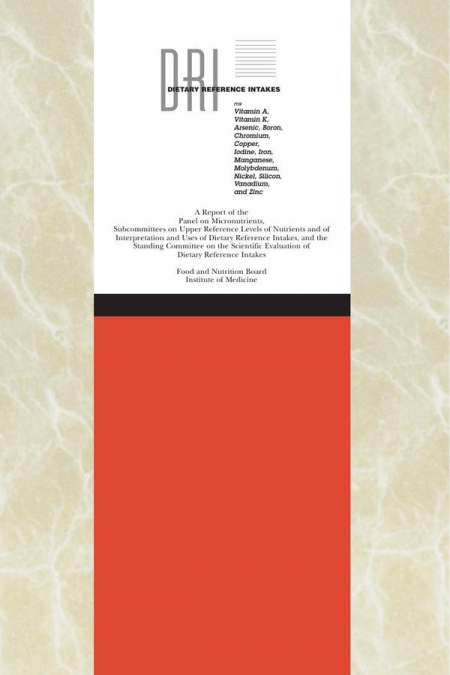

Dietary Reference Intakes for Vitamin A, Vitamin K, Arsenic, Boron, Chromium, Copper, Iodine, Iron, Manganese, Molybdenum, Nickel, Silicon, Vanadium, and Zinc

Dietary Reference Intakes for Vitamin A, Vitamin K, Arsenic, Boron, Chromium, Copper, Iodine, Iron, Manganese, Molybdenum, Nickel, Silicon, Vanadium, and Zinc

AA.VV

97,71 €
IVA incluido
Disponible
Editorial:
National Academies Press
Año de edición:
2002
ISBN:
9780309072908
97,71 €
IVA incluido
Disponible

Selecciona una librería:

  • Librería Samer Atenea
  • Librería Aciertas (Toledo)
  • Kálamo Books
  • Librería Perelló (Valencia)
  • Librería Elías (Asturias)
  • Donde los libros
  • Librería Kolima (Madrid)
  • Librería Proteo (Málaga)

This volume is the newest release in the authoritative series issued by the National Academy of Sciences on dietary reference intakes (DRIs). This series provides recommended intakes, such as Recommended Dietary Allowances (RDAs), for use in planning nutritionally adequate diets for individuals based on age and gender. In addition, a new reference intake, the Tolerable Upper Intake Level (UL), has also been established to assist an individual in knowing how much is ’too much’ of a nutrient. Based on the Institute of Medicine’s review of the scientific literature regarding dietary micronutrients, recommendations have been formulated regarding vitamins A and K, iron, iodine, chromium, copper, manganese, molybdenum, zinc, and other potentially beneficial trace elements such as boron to determine the roles, if any, they play in health. The book also:Reviews selected components of food that may influence the bioavailability of these compounds.Develops estimates of dietary intake of these compounds that are compatible with good nutrition throughout the life span and that may decrease risk of chronic disease where data indicate they play a role.Determines Tolerable Upper Intake levels for each nutrient reviewed where adequate scientific data are available in specific population subgroups.Identifies research needed to improve knowledge of the role of these micronutrients in human health.This book will be important to professionals in nutrition research and education.
Artículos relacionados

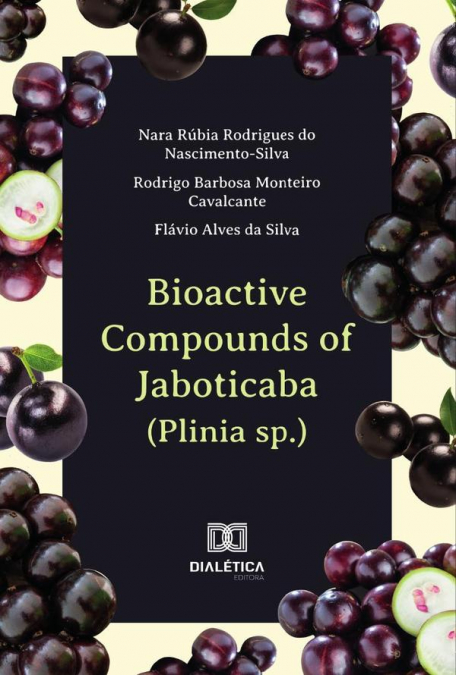
  • Bioactive Compounds Of Jaboticaba (Plinia Sp.)
    Flávio Alves Da Silva / Nara Rúbia Rodrigues Do Nascimento-Silva / Rodrigo Barbosa Monteiro Cavalcante
    The Whole Jaboticaba Fruit Stood Out For Its High Levels Of Total Polyphenols, Mainly Anthocyanins (Cyanidin And Delphinidin), Ellagic Acid, Methylellagic Acid, Gallic Acid, Myricetin, Quercetin, Castalagin, Pedunculagin And Vescalagin. When Evaluating The Behavior Of These Compounds After In Vitro Digestion, It Is Observed That Anthocyanins Did Not Suffer As Much In The Saliva...
    Disponible

    11,96 €

  • Obesidad, genética y entorno. El papel de la flexibilidad metabólica
    Fundación alimentación saludable
    Afortunadamente, gracias a la investigación, somos más conscientes de que la obesidad no es una patología que se deba en exclusiva a la desidia ola falta de voluntad del sujeto y que los mensajes de culpabilidad o estigmatización hacia los pacientes no sólo no ayudan a poner freno al sobrepeso, sino que pueden perjudicar seriamente su salud mental. También sabemos, y esto es mu...
    Disponible

    20,00 €

  • FOOD AND NUTRITION ECONOMICS P
    GEORGE C DAVIS
    ...
    Disponible

    118,89 €

  • Maternal-Fetal Nutrition During Pregnancy and Lactation
    ...
  • The Myths About Nutrition Science
    David Lightsey
    The Myths About Nutrition Science provides an authoritative, yet readily understandable, overview of the common misunderstandings that are commonplace within consumer or athletic communities regarding the food production process and nutrition science, which may affect their physical development, performance, and long-term health ...
  • Local Food Environments
    Allison E. Karpyn / Kimberly B. Morland / Yael M. Lehmann
    This second edition contains four sections including (1) disparities between local food environments in the United States; (2) effect of restricted local food environments on dietary intake; (3) interventions to local food environment and their impact on communities; and (d) macro-level influence on the development of local food environments. ...