
Inicio > Derecho > Derecho internacional > Die Zukunft des Automobilhandels nach Auslaufen der GVO 1475/95
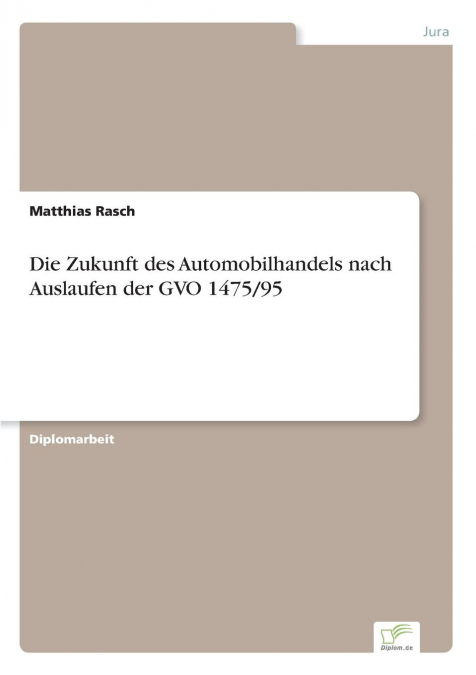
Die Zukunft des Automobilhandels nach Auslaufen der GVO 1475/95

Die Zukunft des Automobilhandels nach Auslaufen der GVO 1475/95

Matthias Rasch

57,02 €
IVA incluido
Disponible
Editorial:
diplom.de
Año de edición:
2002
Materia
Derecho internacional
ISBN:
9783838659602
57,02 €
IVA incluido
Disponible

Selecciona una librería:

  • Librería Samer Atenea
  • Librería Aciertas (Toledo)
  • Kálamo Books
  • Librería Perelló (Valencia)
  • Librería Elías (Asturias)
  • Donde los libros
  • Librería Kolima (Madrid)
  • Librería Proteo (Málaga)

Inhaltsangabe:Einleitung: In der vorliegenden Diplomarbeit erhält der interessierte Leser einen Überblick über die künftigen Regelungen bei Vertriebs- und Kundendienstvereinbarungen im Kraftfahrzeugsektor. Die Intention dieser Arbeit liegt in der Darstellung des rechtlichen Rahmenwerks nach dem Wegfall der seit 1995 geltenden Gruppenfreistellungsverordnung GVO 1475/95. Dabei erfolgt eine klassische Gegenüberstellung der Vorschriften des bisherigen und des neuen rechtlichen Rahmenwerks. Anhand dieser Zielsetzung wird deutlich, dass es sich schwerpunktmäßig um eine rechtliche Untersuchung handelt, die mit betriebswirtschaftlichen Erkenntnissen und Betrachtungsweisen untermauert wird. Gang der Untersuchung: Diesbezüglich wird zunächst eine allgemeine Darstellung der einschlägigen Rechtsgrundlagen des europäischen Wettbewerbs- und Kartellrechts vorgenommen. Was weiterhin eine ausführliche Erläuterung begrifflicher Grundlagen, insbesondere zum Wettbewerbsbegriff und dem Wesen einer Gruppenfreistellungsverordnung beinhaltet. Im Anschluss daran erfolgt ein historischer Rückblick über Gruppenfreistellungen im Kraftfahrzeugsektor und deren Entstehung. Dabei wird auch der Sinn und Zweck derartiger Ausnahmeregelungen erörtert beziehungsweise auf die Rechtfertigung einer branchenbezogenen Freistellungsverordnung eingegangen. Bevor die Modifikationen des künftigen Rechtsrahmens vorgestellt werden, ist es unbedingt notwendig auch die bestehende GVO 1475/95 zu würdigen, zumal diese wiederum die Grundlage der neuen sektorspezifischen GVO 1400/2002 bildet. Auf der Basis der Funktionsweise der bisherigen Vorschriften, insbesondere deren Schwachstellen und Kritikpunkte, wird im weiteren Verlauf der Untersuchung eine Darstellung möglicher Szenarien vorgenommen. Dabei werden künftige Entwicklungen, Auswirkungen und Einflüsse, die von der neuen Verordnung ausgehen können näher betrachtet. Mit welchen Veränderungen die Automobilbranche nach dem Wegfall der GVO 1475/95 tatsächlich ko
Artículos relacionados

  • Comparative regulation, economic analysis, and applications of private equity in the united states and european union
    Irini Liakopoulou
    The present work examines the economics and legal doctrine of private equity. After a consideration of private equity’s origins, the book will explore the evolution of private equity in the United States and Europe. The reference economic model then will be reconstructed, with particular attention to financial flows to and from private equity firms and funds. This reconstructio...
  • Complicity in International Law
    Dimitris Liakopoulous
    Complicity in International Law aims to analyze questions arising from a state’s complicity in conflict with another state or an international organization. On the basis of international legal provisions, a state that assists the illicit fact of another state or an international organization in turn commits an offense if it is aware of the main fact and is bound by the same obl...
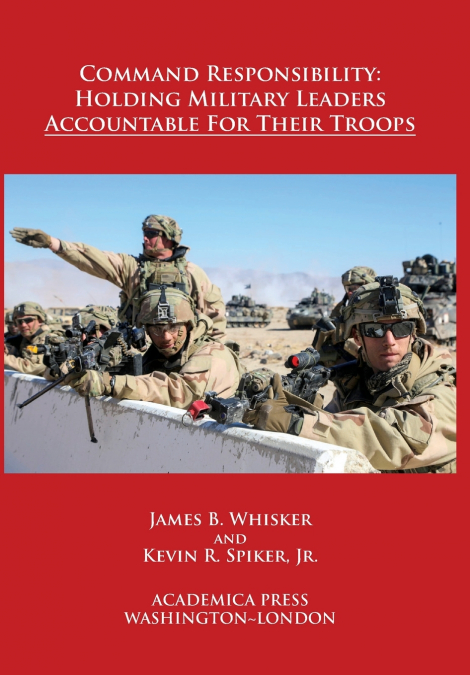
  • Command responsibility
    James B Whisker / Kevin R Spiker
    Command responsibility, or executive accountability, assumes that leaders are responsible for the actions of their subordinates. If subordinates misbehave, violate basic moral laws, transgress international law, or thwart international standards of behavior, their leader may be called before to justice. Standards that set the boundaries of human action have been evolving for ma...
  • International Organizations and Reparations
    Dimitris Liakopoulos
    In the first part of this book, noted legal scholar Dimtris Liakopoulos deals with reconstructing the legal regulatory framework governing human rights violations in the activities of organizations. After identifying rules that are generally applicable to organizations’ offenses and govern the profile of reparations, this study assesses primary rules that guarantee the right to...
  • International Organizations and Legal Sanctions Against Governments
    Dimitris Liakopoulos
    This book examines the relationship between governments and international organizations under international law. After surveying the policing powers of international organizations under international law, it illustrates some normative aspects of law that distinguish regulation from enforcement via study of recent legal cases before international judicial bodies. According to Di...
  • The EU Foreign Subsidies Regulation
    Andreas Reindl / Isabelle Van Damme
    'The EU Foreign Subsidies Regulation' is a pioneering manual authored by legal experts Andreas Reindl and Isabelle Van Damme. This essential guide, the first of its kind, is tailored for legal practitioners, offering a thorough exploration of the tools and mechanisms embedded within this novel European regulatory framework. The authors meticulously dissect the EU Foreign Subsid...

Otros libros del autor

  • Der Schutz geographischer Herkunftsangaben im europäischen Wirtschaftsraum
    Matthias Rasch
    Inhaltsangabe:Einleitung: Die vorliegende Arbeit wurde im Rahmen des Seminars zum internationalen Wirtschaftsverkehrsrecht an der FH Aschaffenburg im Studienschwerpunkt Handel und Industrie erstellt. Sie zeigt die kennzeichenrechtlichen Schutzvorschriften für geographische Herkunftsangaben sowohl durch nationale als auch durch europäische Rechtsvorschriften auf. Der Schutz de...
    Disponible

    70,31 €