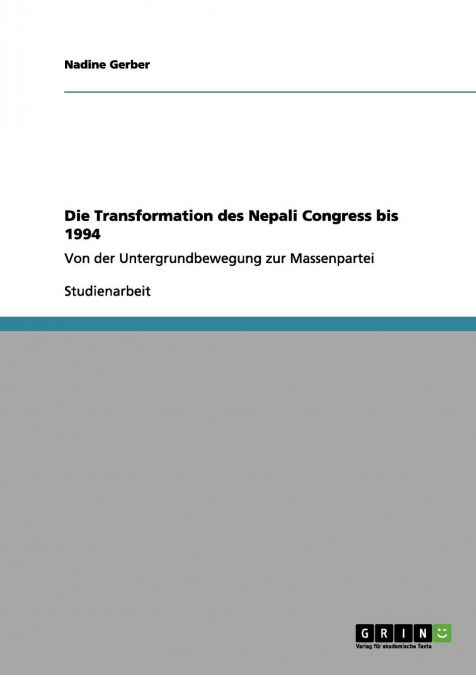

Die Transformation des Nepali Congress bis 1994

Die Transformation des Nepali Congress bis 1994

Nadine Gerber

13,23 €
IVA incluido
Disponible
Editorial:
GRIN Publishing
Año de edición:
2011
Materia
Diplomacia
ISBN:
9783656076339
13,23 €
IVA incluido
Disponible

Selecciona una librería:

  • Librería Samer Atenea
  • Librería Aciertas (Toledo)
  • Kálamo Books
  • Librería Perelló (Valencia)
  • Librería Elías (Asturias)
  • Donde los libros
  • Librería Kolima (Madrid)
  • Librería Proteo (Málaga)

Studienarbeit aus dem Jahr 2011 im Fachbereich Politik - Internationale Politik - Region: Südasien, Note: 1,3, Ruprecht-Karls-Universität Heidelberg, Sprache: Deutsch, Abstract: 1. Einleitung Der Nepali Congress (NC) gründete sich nach dem Volksaufstand 1950 und war die erste Partei, die im von Unruhen geplagten Nepal ihr Zuhause fand. Bedingt durch ständig wechselnde politische Bedingungen war und ist das Überleben der Partei von der Fähigkeit einer adäquaten Transformationsqualität abhängig. Viele dieser Übergänge hat der NC erfolgreich gemeistert, nahm aktiv an Versuchen zur Besserung der politischen Landschaft teil. Jedoch gab es im Vergleich zu den Anforderungen 1950 und 1990 signifikante Unterschiede im Anforderungsspektrum, welches die Partei zu bewältigen hatte. Nach der erfolgreichen demokratischen Konsolidierung 1950 konnte die Partei vom Image des jahrzehntelangen Untergrundkampfes für Demokratie zehren, der Status der Partei war praktisch unangefochten. Die erfolgreiche demokratische Bewegung Jana Andolan belebte nicht nur die Parteienlandschaft wieder sondern restrukturierte die Politik Nepals als ein parlamentarisches System in einer konstitutionellen Monarchie. Der Nepali Congress musste nach der Einführung des Mehrparteiensystems ihr Profil schärfen, vor allem im Hinblick auf die ernstzunehmende Konkurrenz der kommunistischen Partei (CPN-UML). Sie war nun nicht mehr nur ideologisch determiniert sondern war vom Machtaufbau abhängig. Zusätzlich wurde sie mit ernsthaften innerparteilichen Konflikten konfrontiert. Die Entwicklung des NC kann mit drei Entwicklungsstadien erklärt werden: Parteiformation, Überlebenskampf und Parteiaufbau. Im Folgenden wird die Parteiformation im historischen Kontext ihrer Entstehung, ihr Kampfes während des Panchayat Systems und ihre Rolle im parlamentarischen System ab 1990 mithilfe des Transformationsmodells von Krishna Hachhethu untersucht. Die Arbeit will weniger einen detaillierten Einblick in spezifische historische
Artículos relacionados

  • How Statesmen Think
    Robert Jervis
    Robert Jervis has been a pioneering leader in the study of the psychology of international politics for more than four decades. How Statesmen Think presents his most important ideas on the subject from across his career. This collection of revised and updated essays applies, elaborates, and modifies his pathbreaking work. The result is an indispensable book for students and sch...
    Disponible

    43,09 €

  • Tower of Babble
    Dore Gold
    ...
    Disponible

    16,40 €

  • The Diplomatic Relations of the United States with Haiti, 1776-1891
    Rayford W. Logan
    The relations of the United States with Haiti have been different from American relations with any other nation; they have been vital and at times even dramatic. They climaxed in 1891 when the United States failed to make Haiti lease her Mole St. Nicolas. This failure constitutes an amazing episode in American diplomatic hostory. Recounting the story of Haiti’s struggle for ind...
    Disponible

    76,25 €

  • Diplomacy. the Written Art
    Ozichi Alimole
    The author seeks to redefine written diplomacy in its true meaning: the art of learning to write in a particular kind of language and mood. He seeks to refocus attention on the significance of diplomatic communication as one of the defining characteristics of diplomacy. A wide variety of correspondence encountered by diplomats is explained, with an analysis of each form of corr...
    Disponible

    57,94 €

  • West Africa’s Trouble Spots and the Impe
    Osita Agbu
    This monograph highlights the necessity for taking preventive measures in the form of peace-building as a sustainable and long-term solution to conflicts in West Africa, with a special focus on the Mano River Union countries. Apart from the Mano River Union countries, efforts at resolving other conflicts in say, Guinea Bissau, Senegal, Côte d’Ivoire and Nigeria, have suffered f...
    Disponible

    58,17 €

  • The Evolution Of UAE Foreign Policy
    GEW Intelligence Unit
    The research background of this book focuses on the historical evolution and strategic development of the United Arab Emirates’ (UAE) foreign policy from its formation to the present day.u2029The research methodology proposed in this book includes a historical analysis of the UAE’s foreign policy, examining key events and strategies that have shaped its current principles and g...
    Disponible

    28,96 €