

Inicio > Sociedad y ciencias sociales > Psicología > Die Sozialen Ursprünge Psychologischer Diagnostik
Die Sozialen Ursprünge Psychologischer Diagnostik

Die Sozialen Ursprünge Psychologischer Diagnostik

Harald Grünwald

79,30 €
IVA incluido
Disponible
Editorial:
Springer Nature B.V.
Año de edición:
1980
Materia
Psicología
ISBN:
9783798505698
79,30 €
IVA incluido
Disponible

Selecciona una librería:

  • Librería Samer Atenea
  • Librería Aciertas (Toledo)
  • Kálamo Books
  • Librería Perelló (Valencia)
  • Librería Elías (Asturias)
  • Donde los libros
  • Librería Kolima (Madrid)
  • Librería Proteo (Málaga)

Psychologische Diagnostik verdient aus drei GrUnden besondere Aufmerksamkeit: a) wegen ihrer herausragenden Rolle fUr die Berufspraxis des Diplompsychologen; b) wegen ihrer ,schicksalshaften’ Bedeutung fUr die ,Betroffenen’; und c) wegen der anhaltenden Kontroversen urn ihre angemessene Konzeptualisierung. l In der vorliegenden Arbeit werden Konzeptionen der Psychodiagnostik unter einer integrativen Perspektive betrachtet, die wissenschaftstheoretische, -historiographische 2 und -soziologische Aspekte zu verbinden versucht . Dabei werden, bei BerUcksichti­ gung dreier, deutlich von einander abgrenzbarer - aber eng aufeinander bezogener - Ebenen: a) einer Ebene der Beziehung von wissenschaftlichem Untersucher und Untersuchtem; b) einer Ebene der Strukturen und Prozesse in Wissenschaftlergemeinschaften; c) einer Ebene der ein- und wechselseitigen Beeinflussung von wissenschaftsexternen und -internen Faktoren; synchrone und diachrone Analyseschritte als notwendig zusammengehorend betrachtet. Konzeptionen psychologischer Diagnostik zu analysieren, heiil>t in diesem Zusam­ menhang, Psychodiagnostik nicht losgelost von Entstehungs- und Verbreitungsbedin­ gungen zu betrachten, also nicht unter einem Produktaspekt, sondern bedeutet ge­ rade, den inner- und au1l>erwissenschaftlichen Entstehungs- und Verbreitungskontext systematisch mit einzubeziehen, also den Produktionsaspekt herauszustellen. Bezogen auf die drei Analyseebenen heiBt dies: a) die in erster Linie impliziten Annahmen und Voraussetzungen zu Subjekt, Objekt und DiagnoseprozeB - also die ,verborgenen’ sozialen/anthropologischen An­ nahmen von Psychodiagnostik - herauszuarbeiten, b) die community-Gebundenheit von Diagnostikkonzeptionen - also den ,sozial­ psycho’-logischen Charakter von Diagnostikforschung - zu demonstrieren, c) die Abhangigkeit und Einbettung von Diagnostikforschung in gesellschaftliche Zusammenhange - also die sozialen, wissenschaftsexternen Regulative von Dia­ gnostikforschung - herauszustellen.
Artículos relacionados

  • Drinkers of Infinity
    Arthur Koestler
    This selection of essays, book-reviews, broadcast talks and papers delivered to learned societies reflects the extraordinary breadth of Arthur Koestler’s interests. From the trial of Galileo to the pleasures of canoeing down the Loire, from a detailed examination of the ‘memory’ of flatworms to an equally detailed examination of the futility of quarantining dogs, the author wri...
    Disponible

    17,24 €

  • Gordy the Rabbit has ADHD
    Jessie Shepherd
    Often when people are given a mental health disorder diagnosis the weaknesses are clear and overwhelmingly emphasized, while the strengths are ignored or forgotten. The mental health children's book series 'What Mental Disorder?' challenges the stigma against therapy and diagnosis. It enlists the reader to view the character as a whole being and not as a mental issu...
    Disponible

    16,30 €

  • The Paradoxical Ego
    Eugene Halliday / Zhu Kabere
    Three particular themes are basic to this study. First, that the human race and its environment are involved in a slowly progressive process of revelation and understanding of its inherent features; and that we are all participating in this ongoing evolutionary cycle. Second, and closely related to the first tenet, man is not separable from his environment. We all share in this...
    Disponible

    14,56 €

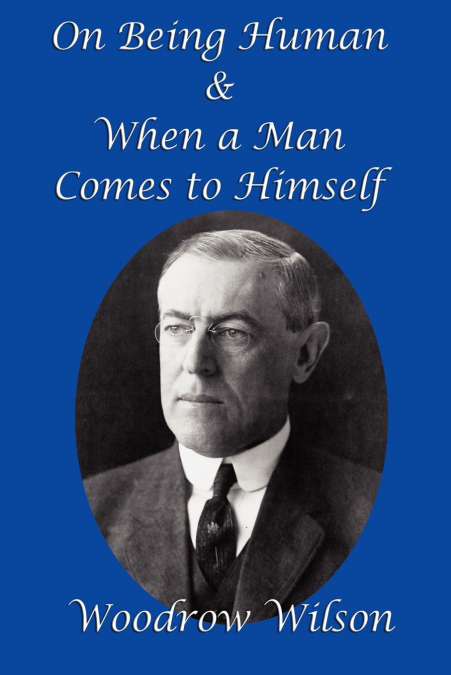
  • On Being Human and When a Man Comes to Himself
    Woodrow Wilson
    Before he became the 28th President of the United States (1913-21), the 34th Governor of New Jersey (1911-13), or even the 13th President of Princeton University (1902-10), Woodrow Wilson (1856-1924) was a scholar and professor. In 1885, he received his Ph.D. in history and political science from Johns Hopkins University, and in 1897, he was granted tenure at Princeton Universi...
    Disponible

    6,28 €

  • Bridge Over The River Why
    David Cooper / Deborah Cooper
    'In Bridge Over the River Why, the Coopers have succeeded in a dual task documenting their own journey through the grief of losing their son Eli by suicide, while at the same time providing a valuable resource for anyone who has had to face the same terrible tragedy. They start with the premise that 'doing and feeling' are the key components of moving forward and have a core me...
    Disponible

    29,39 €

  • Extraordinary Leadership
    Cher Holton
    This transformational leadership book, grounded in state-of-the-art research and proven by real-life application in the trenches, moves beyond traditional leadership theories to introduce you to seven incredible Core Abilities and shows you how to connect with them to become an Extraordinary Leader who can bring out the very best in your people.All the techniques in the world w...
    Disponible

    23,85 €