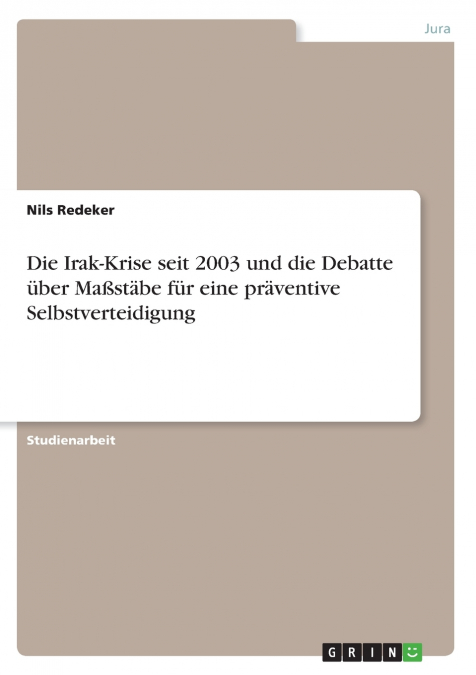

Inicio > Derecho > Derecho internacional > Die Irak-Krise seit 2003 und die Debatte über Maßstäbe für eine präventive Selbstverteidigung
Die Irak-Krise seit 2003 und die Debatte über Maßstäbe für eine präventive Selbstverteidigung

Die Irak-Krise seit 2003 und die Debatte über Maßstäbe für eine präventive Selbstverteidigung

Nils Redeker

22,13 €
IVA incluido
Disponible
Editorial:
GRIN Verlag
Año de edición:
2010
Materia
Derecho internacional
ISBN:
9783640664221
22,13 €
IVA incluido
Disponible

Selecciona una librería:

  • Librería Samer Atenea
  • Librería Aciertas (Toledo)
  • Kálamo Books
  • Librería Perelló (Valencia)
  • Librería Elías (Asturias)
  • Donde los libros
  • Librería Kolima (Madrid)
  • Librería Proteo (Málaga)

Studienarbeit aus dem Jahr 2010 im Fachbereich Jura - Europarecht, Völkerrecht, Internationales Privatrecht, Note: 1,0, Freie Universität Berlin (Fachbereich Rechtswissenschaften), Veranstaltung: Völkerrecht und Außenpolitik, Sprache: Deutsch, Abstract: Der Irak-Krieg 2003, den die USA und ihre „Koalition der Willigen' (Ziegler, 2009: S.329) ohne Legitimation durch den UN-Sicherheitsrat führten, war für viele Beobachter nicht nur eine politische und militärische Krise, sondern zugleich auch eine „Krise des Völkerrechts'. (Haverkamp, 2004: S. 270) Die „Operation Iraqi Freedom' und die Debatte über ihre völkerrechtliche Legitimität stellte einige wesentliche Fragen: Auf welcher Grundlage dürfen Staaten gegeneinander Krieg führen? Wie weit geht der Interpretationsspielraum bei der Auslegung von UN-Resolutionen? Welche Reichweite hat das im Artikel 51 der UN-Charta genannte Recht auf Selbstverteidigung? Ziel dieser Arbeit ist es, einen grundlegenden Überblick über die völkerrechtlichen Fragen, die sich aus dem zweiten Golfkrieg ergaben, zu bieten. Dazu soll im Folgenden zunächst ein kurzer Einblick in die relevante Vorgeschichte und den Verlauf des Krieges (2) gegeben werden. Daraufhin werde ich mich mit dem völkerrechtlichen Gewaltverbot und seinen grundsätzlichen Ausnahmen beschäftigen (3), um daran anschließend die beiden wesentlichen Argumentationsstränge zur völkerrechtlichen Legitimation des Irakkriegs darzustellen und auf ihre Zulässigkeit zu überprüfen. Dabei werde ich zunächst auf eine mögliche Rechtfertigung durch bereits vorhandene UN-Resolutionen eingehen (4), mich danach aber vor allem auf die Debatte der Zulässigkeit von Selbstverteidigung im Falle des zweiten Golfkriegs konzentrieren. (5) Abschließend wird auf dieser Grundlage die völkerrechtliche Legitimität des Irakkrieg beurteilt. (6)
Artículos relacionados

  • Comparative regulation, economic analysis, and applications of private equity in the united states and european union
    Irini Liakopoulou
    The present work examines the economics and legal doctrine of private equity. After a consideration of private equity’s origins, the book will explore the evolution of private equity in the United States and Europe. The reference economic model then will be reconstructed, with particular attention to financial flows to and from private equity firms and funds. This reconstructio...
  • Complicity in International Law
    Dimitris Liakopoulous
    Complicity in International Law aims to analyze questions arising from a state’s complicity in conflict with another state or an international organization. On the basis of international legal provisions, a state that assists the illicit fact of another state or an international organization in turn commits an offense if it is aware of the main fact and is bound by the same obl...
  • Command responsibility
    James B Whisker / Kevin R Spiker
    Command responsibility, or executive accountability, assumes that leaders are responsible for the actions of their subordinates. If subordinates misbehave, violate basic moral laws, transgress international law, or thwart international standards of behavior, their leader may be called before to justice. Standards that set the boundaries of human action have been evolving for ma...
  • International Organizations and Reparations
    Dimitris Liakopoulos
    In the first part of this book, noted legal scholar Dimtris Liakopoulos deals with reconstructing the legal regulatory framework governing human rights violations in the activities of organizations. After identifying rules that are generally applicable to organizations’ offenses and govern the profile of reparations, this study assesses primary rules that guarantee the right to...
  • International Organizations and Legal Sanctions Against Governments
    Dimitris Liakopoulos
    This book examines the relationship between governments and international organizations under international law. After surveying the policing powers of international organizations under international law, it illustrates some normative aspects of law that distinguish regulation from enforcement via study of recent legal cases before international judicial bodies. According to Di...
  • The EU Foreign Subsidies Regulation
    Andreas Reindl / Isabelle Van Damme
    'The EU Foreign Subsidies Regulation' is a pioneering manual authored by legal experts Andreas Reindl and Isabelle Van Damme. This essential guide, the first of its kind, is tailored for legal practitioners, offering a thorough exploration of the tools and mechanisms embedded within this novel European regulatory framework. The authors meticulously dissect the EU Foreign Subsid...