

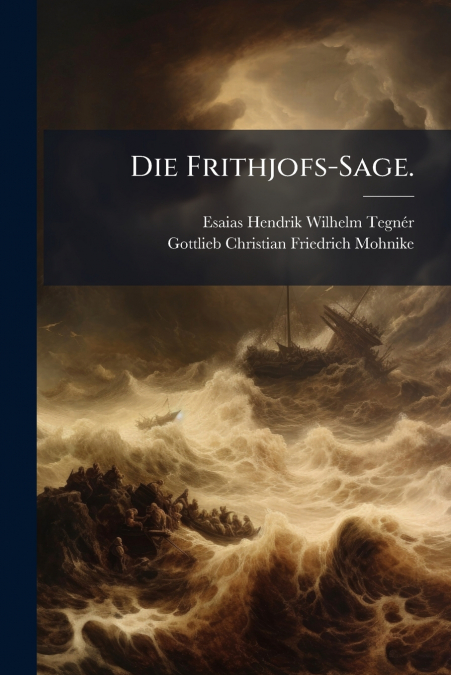
Esaias Hendrik Wilhelm Tegnér / Gottlieb Christian Friedrich Mohnike
 Librería Samer Atenea
 Kálamo Books
 Librería Elías (Asturias)
 Librería Kolima (Madrid)
 Librería Proteo (Málaga)
Die Frithjofs-Sage is a German translation of Esaias Tegnér’s celebrated Swedish epic poem, 'Frithiofs saga.' Originally published in Swedish in 1825 and translated into German by Gottlieb Christian Friedrich Mohnike, this work draws inspiration from the Old Norse Icelandic saga, Friðþjófs saga hins frœkna, weaving a tale of love, heroism, and adventure set against the backdrop of Viking-era Scandinavia. The poem recounts the story of Frithjof, a valiant warrior, and his love for Ingeborg, the beautiful daughter of King Bele. Their romance is fraught with obstacles, including political intrigue and personal trials, which Frithjof must overcome to prove his worth and claim his beloved. Tegnér’s poem is a cornerstone of Swedish Romanticism, and this German rendition makes it accessible to a wider audience, preserving the saga’s timeless themes of courage, loyalty, and the enduring power of love.This work has been selected by scholars as being culturally important, and is part of the knowledge base of civilization as we know it. This work was reproduced from the original artifact, and remains as true to the original work as possible. Therefore, you will see the original copyright references, library stamps (as most of these works have been housed in our most important libraries around the world), and other notations in the work.This work is in the public domain in the United States of America, and possibly other nations. Within the United States, you may freely copy and distribute this work, as no entity (individual or corporate) has a copyright on the body of the work.As a reproduction of a historical artifact, this work may contain missing or blurred pages, poor pictures, errant marks, etc. Scholars believe, and we concur, that this work is important enough to be preserved, reproduced, and made generally available to the public. We appreciate your support of the preservation process, and thank you for being an important part of keeping this knowledge alive and relevant.





