 Librería Samer Atenea
 Kálamo Books
 Librería Elías (Asturias)
 Librería Kolima (Madrid)
 Librería Proteo (Málaga)
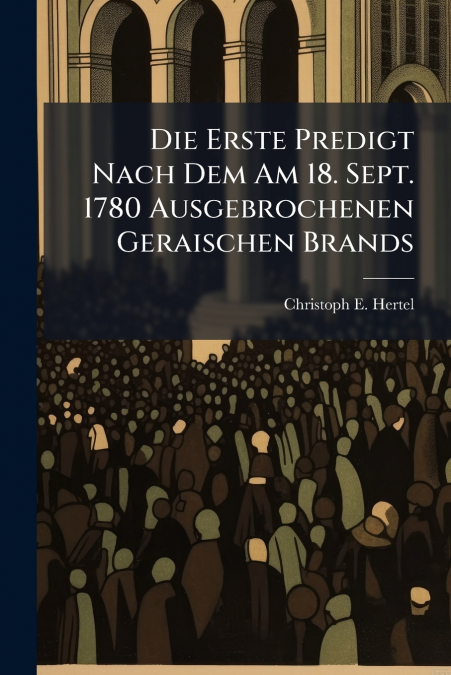
This is a historical sermon titled 'Die Erste Predigt Nach Dem Am 18. Sept. 1780 Ausgebrochenen Geraischen Brands' (The First Sermon After the Gera Fire That Broke Out on September 18, 1780), delivered by Christoph E. Hertel. The sermon, subtitled 'Von Dem Gottgefälligen Verhalten Bey Den Unglücksfallen Unserer Nebenmenschen' (On the God-Pleasing Behavior in the Misfortunes of Our Fellow Men), was given in the city church of Grätz. This English translation offers insights into 18th-century religious thought and social response to disaster. The text provides a window into the moral and theological considerations of the time, reflecting on how individuals should conduct themselves and understand divine will in the face of tragedy. This sermon offers a valuable resource for those interested in religious history, homiletics, and the social impact of catastrophic events. This work has been selected by scholars as being culturally important, and is part of the knowledge base of civilization as we know it. This work was reproduced from the original artifact, and remains as true to the original work as possible. Therefore, you will see the original copyright references, library stamps (as most of these works have been housed in our most important libraries around the world), and other notations in the work.This work is in the public domain in the United States of America, and possibly other nations. Within the United States, you may freely copy and distribute this work, as no entity (individual or corporate) has a copyright on the body of the work.As a reproduction of a historical artifact, this work may contain missing or blurred pages, poor pictures, errant marks, etc. Scholars believe, and we concur, that this work is important enough to be preserved, reproduced, and made generally available to the public. We appreciate your support of the preservation process, and thank you for being an important part of keeping this knowledge alive and relevant.