

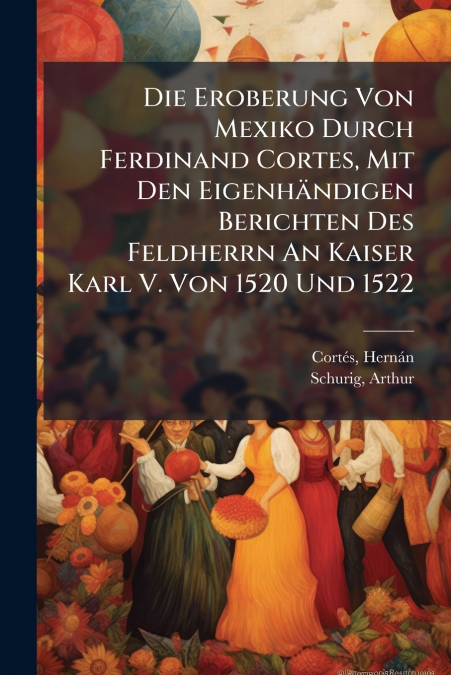
Cortés Hernán 1485-1547 / Schurig Arthur 1870-1929
 Librería Samer Atenea
 Kálamo Books
 Librería Elías (Asturias)
 Librería Kolima (Madrid)
 Librería Proteo (Málaga)
Die Eroberung von Mexiko durch Ferdinand Cortes bietet einen detaillierten Einblick in die Eroberung Mexikos durch Hernán Cortés, basierend auf seinen eigenen Berichten an Kaiser Karl V. aus den Jahren 1520 und 1522. Diese Sammlung von Primärquellen, herausgegeben von Arthur Schurig, bietet einen authentischen und unmittelbaren Bericht über die Ereignisse, Strategien und Herausforderungen während der entscheidenden frühen Phasen der spanischen Kolonialisierung in Mexiko. Der Band beleuchtet nicht nur die militärischen Aspekte der Eroberung, sondern auch die kulturellen Begegnungen und Konflikte zwischen den spanischen Konquistadoren und den aztekischen Völkern. Durch Cortés’ eigene Worte erhalten die Leser ein tiefes Verständnis für die Denkweise, Motivationen und Ziele des Feldherrn. Diese historische Dokumentation ist von unschätzbarem Wert für Historiker, Studenten und alle, die sich für die Geschichte Lateinamerikas und die frühe Kolonialzeit interessieren.This work has been selected by scholars as being culturally important, and is part of the knowledge base of civilization as we know it. This work was reproduced from the original artifact, and remains as true to the original work as possible. Therefore, you will see the original copyright references, library stamps (as most of these works have been housed in our most important libraries around the world), and other notations in the work.This work is in the public domain in the United States of America, and possibly other nations. Within the United States, you may freely copy and distribute this work, as no entity (individual or corporate) has a copyright on the body of the work.As a reproduction of a historical artifact, this work may contain missing or blurred pages, poor pictures, errant marks, etc. Scholars believe, and we concur, that this work is important enough to be preserved, reproduced, and made generally available to the public. We appreciate your support of the preservation process, and thank you for being an important part of keeping this knowledge alive and relevant.





