
Inicio > Derecho > Derecho internacional > Die Entstehung der Europäischen Gemeinschaften und ihre Reform durch die Verträge von Maastricht, Amsterdam und Nizza
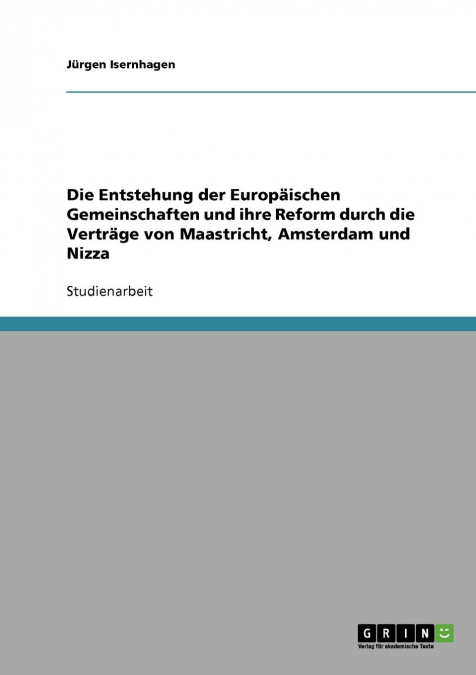
Die Entstehung der Europäischen Gemeinschaften und ihre Reform durch die Verträge von Maastricht, Amsterdam und Nizza

Die Entstehung der Europäischen Gemeinschaften und ihre Reform durch die Verträge von Maastricht, Amsterdam und Nizza

Die Entstehung der Europäischen Gemeinschaften und ihre Reform durch die Verträge von Maastricht, Amsterdam und Nizza

Jürgen Isernhagen

14,76 €
IVA incluido
Disponible
Editorial:
GRIN Verlag
Año de edición:
2007
Materia
Derecho internacional
ISBN:
9783638729437
14,76 €
IVA incluido
Disponible

Selecciona una librería:

  • Librería Samer Atenea
  • Librería Aciertas (Toledo)
  • Kálamo Books
  • Librería Perelló (Valencia)
  • Librería Elías (Asturias)
  • Donde los libros
  • Librería Kolima (Madrid)
  • Librería Proteo (Málaga)

Studienarbeit aus dem Jahr 2002 im Fachbereich Jura - Europarecht, Völkerrecht, Internationales Privatrecht, Note: bestanden, Hochschule Osnabrück, Veranstaltung: Seminar Europäische Integration, 19 Quellen im Literaturverzeichnis, Sprache: Deutsch, Abstract: In der Arbeit werden die Entstehung der Europäischen Gemeinschaften und ihre historische Entwicklung skizziert. Angesichts der mehr als 50-jährigen Geschichte beleuchtet die Darstellung einzelne Aspekte, die eine Antwort auf die Frage ermöglichen, ob durch das Primäre Gemeinschaftsrecht, also die Römischen Verträge und insbesondere ihre Reformen durch die Verträge von Maastricht, Amsterdam und Nizza ein institutioneller Rahmen geschaffen wurde, der eine tragfähige Basis für die Osterweiterung der Europäischen Union bietet und einen erfolgreichen Abschluss des Weges der Europäischen Integration ermöglicht. Eingeleitet wurde der Prozess der Europäischen Integration insbesondere durch den Schuman-Plan. Die Ereignisse, die in unmittelbarem Zusammenhang mit der Gründung der EG stehen, werden vor dem Hintergrund der unterschiedlichen Interessenlagen verständlich, als da sind 1. Volkswirtschaftliche Bedürfnisse 2. Globale Sicherheitsinteressen 3. Furcht vor den Deutschen 4. Psychologische Interioritätsgefühle Gemeinsame Ziele der Europäer erforderten jedoch von Beginn an nicht, dass sich die potenziellen Mitgliedsstaaten auf ein einheitliches Konzept einigten, um die Ziele zu erreichen. Zwei Organisationsprinzipien konkurrierten bereits bei der Gründung des Europarates, des ersten nationenübergreifenden Forums zur Umsetzung des Integrationsgedankens, am 5. Mai 1949 miteinander. Für die Gestaltung der europäischen Einheit: kamen die Organisation als Staatenbund und als Bundesstaat in Betracht. Aber wie in der Folgezeit häufiger feststellbar, hat dieser europäische Gegensatz auch eine fruchtbare Seite. Da es keine starre Festlegung auf ein einziges Modell für Europa gibt, kann der Einigungsprozess äußerst pragmatis

Artículos relacionados

  • Comparative regulation, economic analysis, and applications of private equity in the united states and european union
    Irini Liakopoulou
    The present work examines the economics and legal doctrine of private equity. After a consideration of private equity’s origins, the book will explore the evolution of private equity in the United States and Europe. The reference economic model then will be reconstructed, with particular attention to financial flows to and from private equity firms and funds. This reconstructio...
  • Complicity in International Law
    Dimitris Liakopoulous
    Complicity in International Law aims to analyze questions arising from a state’s complicity in conflict with another state or an international organization. On the basis of international legal provisions, a state that assists the illicit fact of another state or an international organization in turn commits an offense if it is aware of the main fact and is bound by the same obl...
  • Command responsibility
    James B Whisker / Kevin R Spiker
    Command responsibility, or executive accountability, assumes that leaders are responsible for the actions of their subordinates. If subordinates misbehave, violate basic moral laws, transgress international law, or thwart international standards of behavior, their leader may be called before to justice. Standards that set the boundaries of human action have been evolving for ma...
  • International Organizations and Reparations
    Dimitris Liakopoulos
    In the first part of this book, noted legal scholar Dimtris Liakopoulos deals with reconstructing the legal regulatory framework governing human rights violations in the activities of organizations. After identifying rules that are generally applicable to organizations’ offenses and govern the profile of reparations, this study assesses primary rules that guarantee the right to...
  • International Organizations and Legal Sanctions Against Governments
    Dimitris Liakopoulos
    This book examines the relationship between governments and international organizations under international law. After surveying the policing powers of international organizations under international law, it illustrates some normative aspects of law that distinguish regulation from enforcement via study of recent legal cases before international judicial bodies. According to Di...
  • The EU Foreign Subsidies Regulation
    Andreas Reindl / Isabelle Van Damme
    'The EU Foreign Subsidies Regulation' is a pioneering manual authored by legal experts Andreas Reindl and Isabelle Van Damme. This essential guide, the first of its kind, is tailored for legal practitioners, offering a thorough exploration of the tools and mechanisms embedded within this novel European regulatory framework. The authors meticulously dissect the EU Foreign Subsid...

Otros libros del autor