

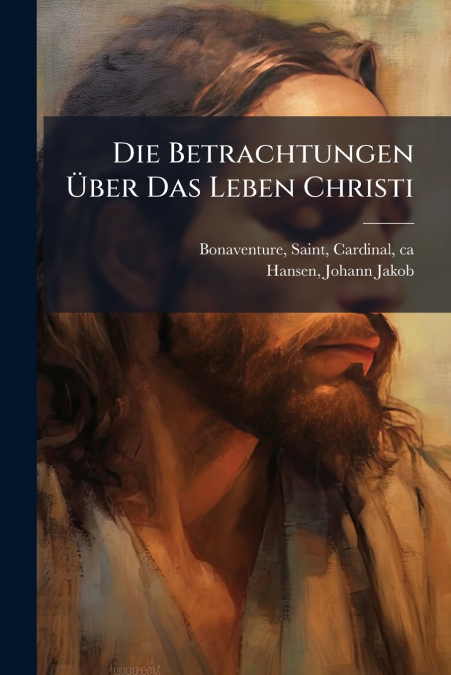
Johann Jakob b. 1840 Hansen / Saint Cardinal ca. 1217-1 Bonaventure
 Librería Samer Atenea
 Kálamo Books
 Librería Elías (Asturias)
 Librería Kolima (Madrid)
 Librería Proteo (Málaga)
Die Betrachtungen Über Das Leben Christi offers a profound exploration into the life of Christ, as contemplated by Saint Bonaventure, a pivotal figure in Christian theology and philosophy. Originally written in Latin, this German translation by Johann Jakob Hansen makes Bonaventure’s spiritual insights accessible to a wider audience. This work, dating back to the 13th century, remains a significant contribution to Christian devotional literature, providing readers with rich material for meditation and spiritual reflection. Bonaventure’s contemplations delve into the key events of Christ’s life, from his birth to his resurrection, inviting readers to deepen their understanding and personal connection with the divine. The book serves not only as a historical artifact but also as a timeless guide for spiritual growth and a closer relationship with God.This work has been selected by scholars as being culturally important, and is part of the knowledge base of civilization as we know it. This work was reproduced from the original artifact, and remains as true to the original work as possible. Therefore, you will see the original copyright references, library stamps (as most of these works have been housed in our most important libraries around the world), and other notations in the work.This work is in the public domain in the United States of America, and possibly other nations. Within the United States, you may freely copy and distribute this work, as no entity (individual or corporate) has a copyright on the body of the work.As a reproduction of a historical artifact, this work may contain missing or blurred pages, poor pictures, errant marks, etc. Scholars believe, and we concur, that this work is important enough to be preserved, reproduced, and made generally available to the public. We appreciate your support of the preservation process, and thank you for being an important part of keeping this knowledge alive and relevant.





