 Librería Samer Atenea
 Kálamo Books
 Librería Elías (Asturias)
 Librería Kolima (Madrid)
 Librería Proteo (Málaga)
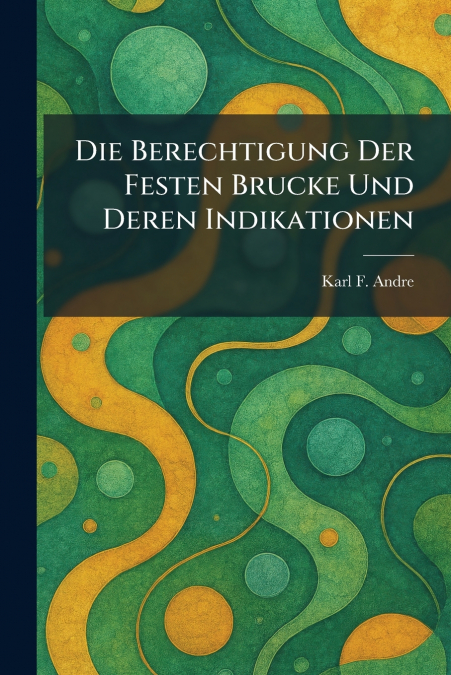
In dem Werk 'Die Berechtigung Der Festen Brucke Und Deren Indikationen' setzt sich Karl Fr. Andre detailliert mit den klinischen und technischen Grundlagen des festsitzenden Zahnersatzes auseinander. Das Buch bietet eine umfassende Analyse der medizinischen Rechtfertigung für die Anwendung von Brückenkonstruktionen in der Zahnheilkunde des frühen 20. Jahrhunderts. Der Autor erläutert präzise die Indikationen, die für eine erfolgreiche prothetische Versorgung ausschlaggebend sind, und beleuchtet dabei sowohl die mechanischen Anforderungen als auch die biologische Integrität des Zahnhalteapparates.Als wertvolles Zeugnis der Medizingeschichte dokumentiert diese Abhandlung den damaligen Stand der Wissenschaft und die Entwicklung klinischer Entscheidungskriterien. Andre diskutiert die Vor- und Nachteile festsitzender Lösungen im Vergleich zu anderen prothetischen Methoden und liefert damit eine fundierte Basis für das Verständnis der modernen Prothetik. Fachleute der Zahnmedizin sowie Historiker der Naturwissenschaften finden in diesem Werk eine tiefgreifende Erörterung der zahnärztlichen Kunst und der Evolution therapeutischer Standards.This work has been selected by scholars as being culturally important, and is part of the knowledge base of civilization as we know it. This work was reproduced from the original artifact, and remains as true to the original work as possible. Therefore, you may see the original copyright references, library stamps (as most of these works have been housed in our most important libraries around the world), and other notations in the work.This work is in the public domain in the United States of America, and possibly other nations. Within the United States, you may freely copy and distribute this work, as no entity (individual or corporate) has a copyright on the body of the work.As a reproduction of a historical artifact, this work may contain missing or blurred pages, poor pictures, errant marks, etc. Scholars believe, and we concur, that this work is important enough to be preserved, reproduced, and made generally available to the public. We appreciate your support of the preservation process, and thank you for being an important part of keeping this knowledge alive and relevant.