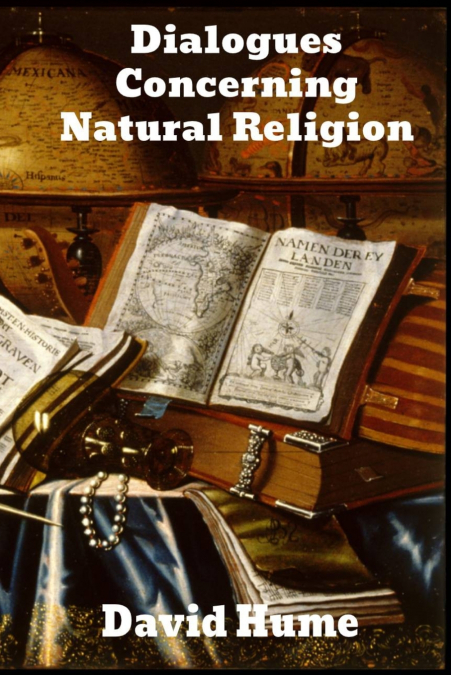

Dialogues Concerning Natural Religion

Dialogues Concerning Natural Religion

Dialogues Concerning Natural Religion

David Hume

14,50 €
IVA incluido
Disponible
Editorial:
Brian Westland
Año de edición:
1779
Materia
Filosofía de la religión
ISBN:
9781989708743
14,50 €
IVA incluido
Disponible

Selecciona una librería:

  • Librería Samer Atenea
  • Librería Aciertas (Toledo)
  • Kálamo Books
  • Librería Perelló (Valencia)
  • Librería Elías (Asturias)
  • Donde los libros
  • Librería Kolima (Madrid)
  • Librería Proteo (Málaga)

Dialogues Concerning Natural Religion is a philosophical work by the Scottish philosopher David Hume. Through dialogue, three philosophers named Demea, Philo, and Cleanthes debate the nature of God's existence. Whether or not these names reference specific philosophers, ancient or otherwise, remains a topic of scholarly dispute. While all three agree that a god exists, they differ sharply in opinion on God's nature or attributes and how, or if, humankind can come to knowledge of a deity.In the Dialogues, Hume's characters debate a number of arguments for the existence of God, and arguments whose proponents believe through which we may come to know the nature of God. Such topics debated include the argument from design—for which Hume uses a house—and whether there is more suffering or good in the world (argument from evil).Hume started writing the Dialogues in 1750 but did not complete them until 1776, shortly before his death. They are based partly on Cicero's De Natura Deorum. The Dialogues were published posthumously in 1779, originally with neither the author's nor the publisher's name.Pamphilus is a youth present during the dialogues. In a letter, he reconstructs the conversation of Demea, Philo, and Cleanthes in detail for his friend Hermippus. He serves as the narrator throughout the piece. At the end of the Dialogues he believes that Cleanthes offered the strongest arguments. However, this could be out of loyalty to his teacher, as this does not seem to reflect Hume's own views on the topic. When other pieces on religion by Hume are taken into consideration, it may be noted that they all end with (apparently) ironic statements reaffirming the truth of Christian religious views. While the irony may be less readily evident in the Dialogues, this would suggest a similar reading of this work's ending.[2] Cicero used a similar technique in his Dialogues.Cleanthes is an "experimental theist"—"an exponent of orthodox empiricism"[3]—who bases his beliefs about God's existence and nature upon a version of the teleological argument, which uses evidence of design in the universe to argue for God's existence and resemblance to the human mind.Philo, according to the predominant view among scholars, is the character who presents views most similar to those of Hume.[4] Philo, along with Demea, attacks Cleanthes' views on anthropomorphism and teleology; while not going as far as to deny the existence of God, Philo asserts that human reason is wholly inadequate to make any assumptions about the divine, whether through a priori reasoning or observation of nature.Demea "defends the Cosmological argument and philosophical theism..." He believes that the existence of God should be proven through a priori reasoning and that our beliefs about the nature of God should be based upon revelation and fideism. Demea rejects Cleanthes' "natural religion" for being too anthropomorphic. Demea objects to the abandonment of the a priori arguments by Philo and Cleanthes (both of whom are empiricists) and perceives Philo to be "accepting an extreme form of skepticism.
Artículos relacionados

  • The Writings of Charles De Koninck
    Charles De Koninck
    The Writings of Charles De Koninck, volumes 1 and 2, present the first English editions of collected works of the Catholic Thomist philosopher Charles De Koninck (1906-1965). Ralph McInerny (1929-2010) was the project editor and prepared the excellent translations. Volume 1 contains writings ranging from De Koninck’s 1934 dissertation at the University of Louvain on the philoso...
  • The Constitution of Shambhala (Vol. 7B of a Treatise on Mind)
    Bodo Balsys
    The theme of the first of the two parts of this volume concerns the feminine deva hierarchy, their relation to Hierarchy and Shambhala. Many concepts are introduced that most seekers have little cognisance (e.g., the nature of the deva Lord Varuna). The Mother of the World’s role is revealed, and the feminine function in cosmos, (e.g., the Pleiades). Advanced teaching concernin...
    Disponible

    44,89 €

  • A Labyrinth Walk Of Life
    Lewis Tagliaferre
    Here is a collection of journaled essays leading to the inevitable belief in theological fatalism, aka Theofatalism. They include arguments from theology, psychology, politics, geology, technology, sociology, economics, history, cosmology and more. With this belief system, you can feel good inside no matter what happens outside. It may take several readings to get it, but anyth...
    Disponible

    13,41 €

  • Religion
    Arthur Schopenhauer
    Collected here are five short essays, A Dialogue, A Few Words on Pantheism, On Books and Reading, Physiognomy, and, Psychological Observations, by the world renowned philosopher Arthur Schopenhauer. ...
  • The Handbook
    Epictetus Epictetus
    No writings of Epictetus himself are really known. His discourses were transcribed and compiled by his pupil Arrian (author of the Anabasis Alexandri). The main work is The Discourses, four books of which have been preserved (out of an original eight). Arrian also compiled a popular digest, entitled the Enchiridion, or Handbook. In a preface to the Discourses, addressed to Luci...
  • The Origin Comes Alive
    Cale Rainer
    Believers and Atheists alike will get a firsthand look at the Divine Presence as it reveals the intimate behaviors and processes that compose a sense of GOD, and how this arose in social consciousness to inspire a global phenomenon known as Religion.The sense of life is taken to the limits of extreme perspective in this somewhat involved, yet intimate look into our social origi...
    Disponible

    9,92 €

Otros libros del autor

  • An Enquiry Concerning Human Understanding
    David Hume
    An Enquiry Concerning Human Understanding (1748) is David Hume’s clear and influential statement of his empiricist philosophy. Hume argues that all human knowledge comes from experience, dividing perceptions into impressions (vivid sensory experiences) and ideas (fainter mental copies). He challenges the notion of innate ideas and emphasizes the limits of human reason.A central...
    Disponible

    15,02 €

  • An Enquiry Concerning Human Understanding
    David Hume
    An Enquiry Concerning Human Understanding (1748) is David Hume’s clear and influential statement of his empiricist philosophy. Hume argues that all human knowledge comes from experience, dividing perceptions into impressions (vivid sensory experiences) and ideas (fainter mental copies). He challenges the notion of innate ideas and emphasizes the limits of human reason.A central...
  • An Enquiry Concerning Human Understanding
    David Hume
    One of the most influential works in Western philosophy, An Enquiry Concerning Human Understanding is David Hume’s brilliant attempt to define the limits and powers of human reason. In clear and elegant prose, Hume confronts the assumptions that underlie our beliefs, casting a skeptical eye on everything from cause and effect to miracles and the nature of knowledge itself.Chall...
    Disponible

    15,55 €

  • An Enquiry Concerning Human Understanding
    David Hume
    One of the most influential works in Western philosophy, An Enquiry Concerning Human Understanding is David Hume’s brilliant attempt to define the limits and powers of human reason. In clear and elegant prose, Hume confronts the assumptions that underlie our beliefs, casting a skeptical eye on everything from cause and effect to miracles and the nature of knowledge itself.Chall...
  • A Treatise of Human Nature
    David Hume
    David Hume’s A Treatise of Human Nature is a groundbreaking work of philosophy exploring the foundations of human understanding, emotion, and morality. With clarity and bold skepticism, Hume challenges assumptions about reason, identity, and causation, laying the groundwork for modern thought and influencing generations of philosophers. ...
    Disponible

    20,69 €

  • The History of England
    David Hume
    Explore the tumultuous years of Restoration England in David Hume’s 'The History of England,' Volume 1, Part F, 'From Charles II to James II.' This meticulously prepared print edition delves into the period spanning the reigns of Charles II and James II, offering a comprehensive historical account of Great Britain during the 17th century.Hume’s detailed narrative examines the p...
    Disponible

    26,12 €