 Librería Samer Atenea
 Kálamo Books
 Librería Elías (Asturias)
 Librería Kolima (Madrid)
 Librería Proteo (Málaga)
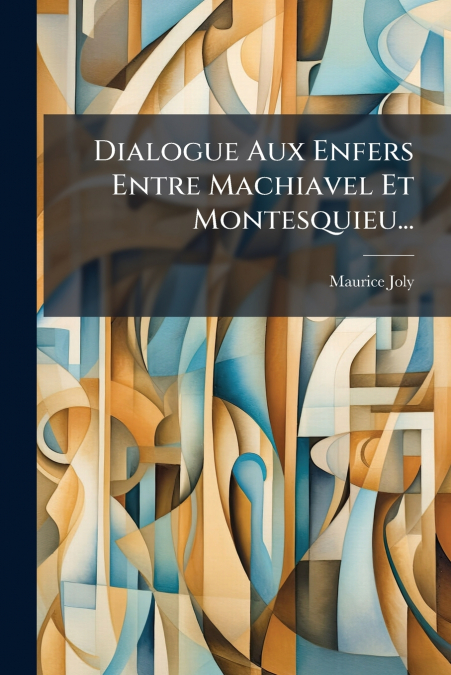
Dialogue aux enfers entre Machiavel et Montesquieu est une œuvre satirique de Maurice Joly publiée anonymement en 1864. Ce dialogue fictif met en scène Machiavel et Montesquieu discutant de politique et de pouvoir dans les enfers. Machiavel y expose les méthodes cyniques et manipulatrices pour établir et maintenir une dictature moderne, tandis que Montesquieu défend les principes de la séparation des pouvoirs et de la liberté. L’œuvre est une critique virulente du Second Empire de Napoléon III et dénonce les dérives autoritaires du régime. Joly utilise le dialogue pour exposer les mécanismes de la propagande, de la corruption et de la répression qui permettent à un despote de contrôler une nation. Le livre a connu une large diffusion et a contribué à alimenter l’opposition à Napoléon III. Malgré sa publication anonyme, l’auteur a été identifié et condamné à la prison. Le 'Dialogue aux enfers' reste une œuvre importante pour comprendre les enjeux de la démocratie et les dangers du totalitarisme.This work has been selected by scholars as being culturally important, and is part of the knowledge base of civilization as we know it. This work was reproduced from the original artifact, and remains as true to the original work as possible. Therefore, you will see the original copyright references, library stamps (as most of these works have been housed in our most important libraries around the world), and other notations in the work.This work is in the public domain in the United States of America, and possibly other nations. Within the United States, you may freely copy and distribute this work, as no entity (individual or corporate) has a copyright on the body of the work.As a reproduction of a historical artifact, this work may contain missing or blurred pages, poor pictures, errant marks, etc. Scholars believe, and we concur, that this work is important enough to be preserved, reproduced, and made generally available to the public. We appreciate your support of the preservation process, and thank you for being an important part of keeping this knowledge alive and relevant.