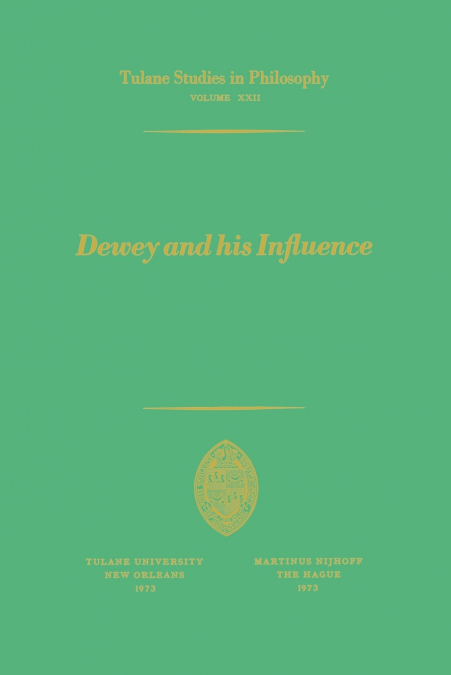

Dewey and his Influence

Dewey and his Influence

R.C. Whittemore

66,92 €
IVA incluido
Disponible
Editorial:
Springer Nature B.V.
Año de edición:
1973
Materia
Ética y filosofía moral
ISBN:
9789024715657
66,92 €
IVA incluido
Disponible

Selecciona una librería:

  • Librería Samer Atenea
  • Librería Aciertas (Toledo)
  • Kálamo Books
  • Librería Perelló (Valencia)
  • Librería Elías (Asturias)
  • Donde los libros
  • Librería Kolima (Madrid)
  • Librería Proteo (Málaga)

To those of us who have been privileged to call him col­ league, Georges Estes Barton is perhaps best and most fondly remembered as the man with a camera. At the beginning of every semester he could be observed carefully photographing each of his arriving students, and while we used to chaff him about this practice, all of us respected the motive behind it. For George Barton was and is a dedicated teacher and in his courses no student ever would be suffered to remain simply a face in the crowd. His favorite teaching technique has always been Socratic discourse, and he is, as Professors Roberts and DuBose remind us in their essays for this volume, a master of the method. In his chosen field of philosophy of education he has long been recognized as a leader, serving several terms on the Executive Committee of the Philosophy of Education Society and in I963 as its President. In I966 St. Edwards University conferred upon him the honorary degree LL.D in recognition of his significant contributions to curriculum development. Following a distinguished career in general education and educational research at the Rochester Institute of Technology and at the University of Chicago, Professor Barton was ap­ pointed in I956 to direct Tulane’s Inter-Disciplinary Program for the Preparation of Liberally Educated Teachers. In Fe­ bruary I962, having seen the program through to a successful conclusion, he joined the Department of Philosophy at Newcomb College as Associate Professor of Philosophy.
Artículos relacionados

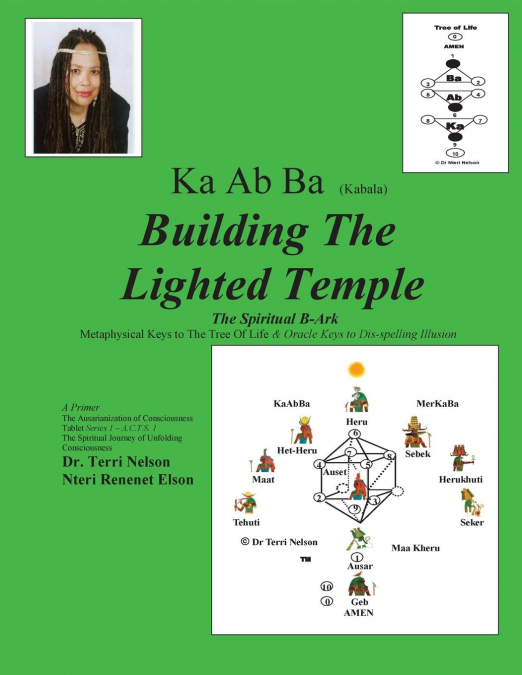
  • Ka Ab Ba Building The Lighted Temple
    Dr Terri R. Nelson / Dr Terri RNelson
    The book KaAbBa Building The Lighted Temple/Metaphysical Keys to the Tree of Life draws a circle that is inclusive of the Afrikan origin of the Ancient Kemetic/Egyptian wisdom. It reveals the undeniable root and link of Ancient Africa to all the religious systems that would develop worldwide. This book is explosive in its power to convey the meaning of KaAbBa, the Medu Neter  (...
    Disponible

    37,41 €

  • Technoethics and the Evolving Knowledge Society
    Rocci Luppicini
    Recently, there has been a major push to rediscover the ethical dimension of technology across the sciences, social sciences, and humanities. Technoethics and the Evolving Knowledge Society: Ethical Issues in Technological Design, Research, Development, and Innovation examines human processes and practices connected to technology embedded within social, political, and moral sph...
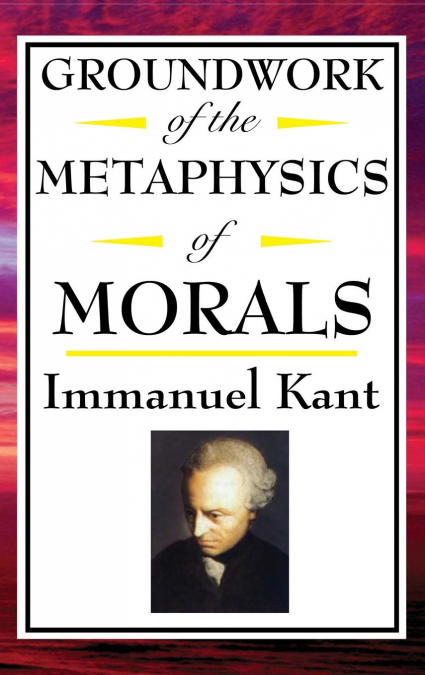
  • Kant
    Immanuel Kant
    Kant’s Groundwork of the Metaphysics of Morals is one of the most important works in modern moral philosophy. It belongs beside Plato, Aristotle, Machiavelli, and Hobbes. Here Kant sets out to articulate and defend the Categorical Imperative - the fundamental principle that underlies moral reasoning - and to lay the foundation for a comprehensive account of justice and human vi...
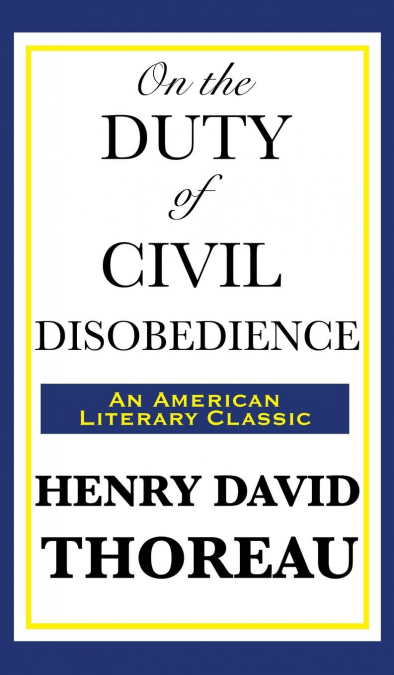
  • On the Duty of Civil Disobedience
    HENRY DAVID THOREAU
    Civil Disobedience argues that citizens should not permit their governments to overrule their consciences, and that they have a duty to avoid allowing their acquiescence to enable the government to make them the agents of injustice. Thoreau was motivated in part by his disgust with slavery and the Mexican-American War, but the sentiments he expresses here are just as pertinent ...
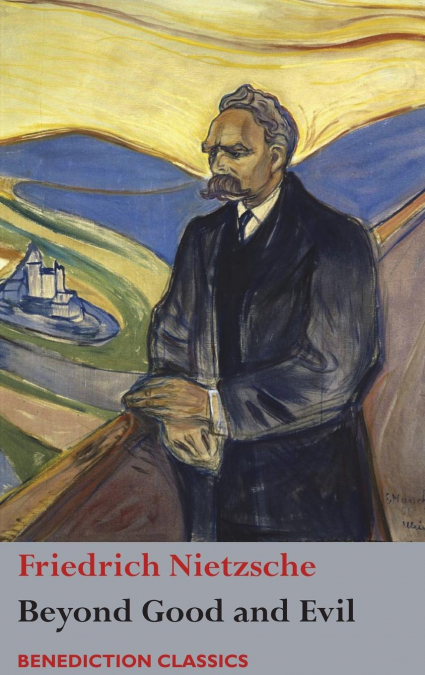
  • Beyond Good and Evil
    Friedrich Nietzsche
    Nietzsche, though primarily a philosopher, wrote widely on art, philology, history, religion, tragedy, culture, and science.  In 1886, at the height of his powers, he published Beyond Good and Evil.  Here he examines much of the best of human thought--dogmatic philosophy, Judeo-Christian morality, science and democracy – and finds it lacking.  Rejecting “slave-morality” he pres...
  • Beyond Good and Evil
    Friedrich Nietzsche
    Nietzsche, though primarily a philosopher, wrote widely on art, philology, history, religion, tragedy, culture, and science.  In 1886, at the height of his powers, he published Beyond Good and Evil.  Here he examines much of the best of human thought--dogmatic philosophy, Judeo-Christian morality, science and democracy – and finds it lacking.  Rejecting “slave-morality” he pres...
    Disponible

    9,99 €

Otros libros del autor

  • The Reach of Philosophy
    R.C. Whittemore
    James Kern Feibleman, born in New Orleans in 1904 of Jewish parents, had an early career as poet, short story writer and novelist, and assistant manager of a department store and partner in an investment company. His formal higher educa­ tion did not extend beyond a semester of study at the Uni­ versity of Virginia. In 1942 he joined the faculty of th...
    Disponible

    67,04 €

  • Studies in Process Philosophy I
    R.C. Whittemore
    ...
    Disponible

    67,13 €