
Inicio > Derecho > Derecho internacional > Developments in Law and Economics in the Italo-Iberoamerican Context
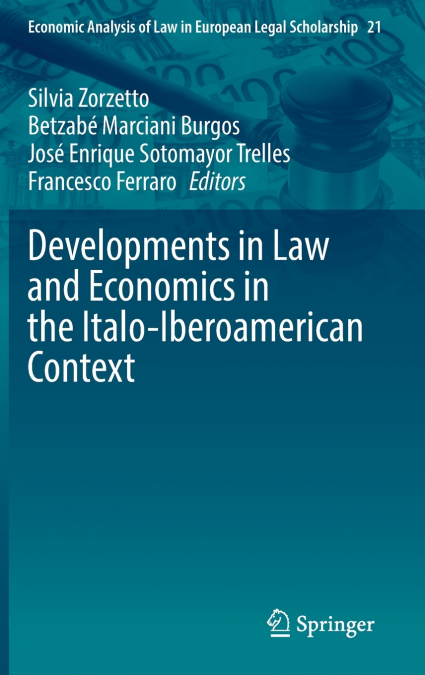
Developments in Law and Economics in the Italo-Iberoamerican Context

Developments in Law and Economics in the Italo-Iberoamerican Context


222,06 €
IVA incluido
Consulta disponibilidad
Editorial:
Springer Nature B.V.
Año de edición:
2025
Materia
Derecho internacional
ISBN:
9783032033161

Selecciona una librería:

  • Librería Samer Atenea
  • Librería Aciertas (Toledo)
  • Kálamo Books
  • Librería Perelló (Valencia)
  • Librería Elías (Asturias)
  • Donde los libros
  • Librería Kolima (Madrid)
  • Librería Proteo (Málaga)

This volume brings together a collection of essays that critically engage with the methodological foundations, historical development, and contemporary applications of Law and Economics across diverse legal systems. Anchored in a comparative and interdisciplinary perspective, the volume reaffirms the enduring relevance of civil law of European origin as a shared legal tradition, while simultaneously scrutinising the promises and limitations of applying economic reasoning to law.The point of departure is twofold: first, the centrality of legal institutions in shaping social order and in conceptualising law not merely as a set of rules, but as a historically contingent and normatively rich system; second, the imperative to interrogate the philosophical, moral, and political assumptions that underpin economic analysis, often obscured under the guise of methodological neutrality.Through a dialogue between international scholars, the chapters address both classical and emerging questions. Core themes include the principle of wealth maximisation, the contested legacy of Pareto efficiency, and the image of the legislator as a rational decision-maker. Equally, the volume delves into contemporary concerns, such as behavioural analysis, the normative implications of nudging strategies in criminal law, and the growing influence of evidence-based legal design.Several essays explore the expressive and symbolic dimensions of law, offering insights into the interaction between legal norms and social meanings—areas where traditional economic models struggle to provide adequate explanatory power. Others examine the legislative process itself through the lens of L&E, engaging with debates on the relative merits of rules versus standards and the cost-benefit calculus in regulatory design.In addition to theoretical investigations, the volume offers historical and contextual analyses of the reception and evolution of L&E in countries such as Mexico, Peru, Colombia, Chile, Ecuador, Portugal, and Italy. These contributions reveal the contingent trajectories of L&E scholarship outside the Anglo-American mainstream, highlighting both its diffusion and its local reinterpretations.Taken together, the essays invite a reconsideration of civil law not only as a legal order but as an intellectual heritage capable of engaging critically with economic paradigms—neither uncritically embracing them nor rejecting them in toto, but seeking a deeper integration that remains attentive to legal specificity, normative coherence, and institutional context.
Artículos relacionados

  • Comparative regulation, economic analysis, and applications of private equity in the united states and european union
    Irini Liakopoulou
    The present work examines the economics and legal doctrine of private equity. After a consideration of private equity’s origins, the book will explore the evolution of private equity in the United States and Europe. The reference economic model then will be reconstructed, with particular attention to financial flows to and from private equity firms and funds. This reconstructio...
  • Complicity in International Law
    Dimitris Liakopoulous
    Complicity in International Law aims to analyze questions arising from a state’s complicity in conflict with another state or an international organization. On the basis of international legal provisions, a state that assists the illicit fact of another state or an international organization in turn commits an offense if it is aware of the main fact and is bound by the same obl...
  • Command responsibility
    James B Whisker / Kevin R Spiker
    Command responsibility, or executive accountability, assumes that leaders are responsible for the actions of their subordinates. If subordinates misbehave, violate basic moral laws, transgress international law, or thwart international standards of behavior, their leader may be called before to justice. Standards that set the boundaries of human action have been evolving for ma...
  • International Organizations and Reparations
    Dimitris Liakopoulos
    In the first part of this book, noted legal scholar Dimtris Liakopoulos deals with reconstructing the legal regulatory framework governing human rights violations in the activities of organizations. After identifying rules that are generally applicable to organizations’ offenses and govern the profile of reparations, this study assesses primary rules that guarantee the right to...
  • International Organizations and Legal Sanctions Against Governments
    Dimitris Liakopoulos
    This book examines the relationship between governments and international organizations under international law. After surveying the policing powers of international organizations under international law, it illustrates some normative aspects of law that distinguish regulation from enforcement via study of recent legal cases before international judicial bodies. According to Di...
  • The EU Foreign Subsidies Regulation
    Andreas Reindl / Isabelle Van Damme
    'The EU Foreign Subsidies Regulation' is a pioneering manual authored by legal experts Andreas Reindl and Isabelle Van Damme. This essential guide, the first of its kind, is tailored for legal practitioners, offering a thorough exploration of the tools and mechanisms embedded within this novel European regulatory framework. The authors meticulously dissect the EU Foreign Subsid...