
Inicio > Lenguas > Lingüistica > Determining the Interrelationship between Society and Language
Determining the Interrelationship between Society and Language

Determining the Interrelationship between Society and Language

Prohlad Roy

106,64 €
IVA incluido
Disponible
Editorial:
KS OmniScriptum Publishing
Año de edición:
2026
Materia
Lingüistica
ISBN:
9786209481949
106,64 €
IVA incluido
Disponible

Selecciona una librería:

  • Librería Samer Atenea
  • Librería Aciertas (Toledo)
  • Kálamo Books
  • Librería Perelló (Valencia)
  • Librería Elías (Asturias)
  • Donde los libros
  • Librería Kolima (Madrid)
  • Librería Proteo (Málaga)

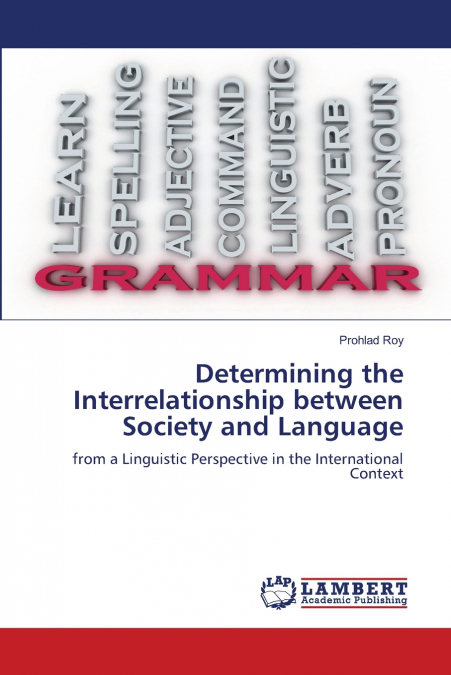
Language is considered a social value within this field, which researches social groups for phenomena such as multilingualism and lingual conflict. It has to do with who is ’authorized’ to use what language, with whom and under what conditions. It has to do with how an individual or group establishes their identity through the language available to them. It seeks to understand individual expression, which involves investing in the linguistic tools one has access to in order to communicate with other people. Sociolinguistics, also called micro-sociolinguistics, is, as Hudson (1996, p. 4) states, the study of language in relation to society. Therefore, the focus here is on the structure of language and how society, with its various aspects including social classes, culture, gender, and ethnicity, influences the kinds of linguistic structures we use and the way we communicate. This leads us to conclude that Sociolinguistics studies, for example, how social situations require a change in the way we talk as there is a difference between ’formal’ and ’informal’ speeches, ’discussions’ and ’arguments’, and ’requests’ and ’demands’.

Artículos relacionados

  • User-Centered Computer Aided Language Learning
    Giorgos Zacharia / Panayiotis Zaphiris
    ...
  • Deep Learning for Natural Language Processing
    Marco Antonio Valenzuela-Escárcega / Mihai Surdeanu
    ...
    Disponible

    47,60 €

  • Deep Learning for Natural Language Processing
    Marco Antonio Valenzuela-Escárcega / Mihai Surdeanu
    ...
  • Lecciones sobre espinosa medrano
    Luis Jaime Cisneros Vizquerra
    La obra de Juan de Espinosa Medrano, apodado en su tiempo «El Lunarejo» (c. 1629-1688), fue uno de los mayores focos de interés académico de Luis Jaime Cisneros (1921-2011). En 1980 aparecieron sus primeros trabajos dedicados a estudiar los textos capitales de Espinosa Medrano (el Apologético en favor de don Luis de Góngora, la Panegírica declamación por la protección de las ci...
    Disponible

    17,63 €

  • Lyre Book
    Matthew Kilbane
    Redefines modern lyric poetry at the intersection of literary and media studies.In The Lyre Book, Matthew Kilbane urges literary scholars to consider lyric not as a genre or a reading practice but as a media condition: the generative tension between writing and sound. In addition to clarifying issues central to the study of modern poetry--including its proximity to popular song...
    Disponible

    50,84 €

  • Translation-mediated Communication in a Digital World
    David Ashworth / Minako O’Hagan
    The Internet is accelerating globalization by exposing organizations and individuals to global audiences. This in turn is driving teletranslation and teleinterpretation, new types of multilingual support, which are functional in digital communications environments. The book describes teletranslation and teleinterpretation by exploring a number of key emerging contexts for langu...
    Disponible

    45,19 €

Otros libros del autor

  • The Influence of Society on Language
    Prohlad Roy
    According to Chomsky’s theory, competence is the child’s innate ability to develop language, enabling them to speak, understand, and produce grammatically correct sentences. A child who can produce all grammatically correct sentences would likely be considered a 'social monster.' Not only does the child learn language from society, but they also learn the appropriate ways to us...
    Disponible

    122,13 €

  • Volksbildung und intellektuelle Entwicklung
    Prohlad Roy
    Wenn gebildete Menschen den ungebildeten Menschen sagen, was sie nicht wissen, werden die Menschen gebildet sein. Es ist nicht möglich, das Volk zu bilden, indem man 'Bücher in die Schule bringt, Grammatik, Literatur, Geometrie' und was auch immer lehrt. Die meisten Menschen im Volk waren Analphabeten. Von Buddhadev bis Sri Chaitanya wurde das Volk lange Zeit durch Vorträge unt...
    Disponible

    73,34 €

  • Educazione popolare e sviluppo intellettuale
    Prohlad Roy
    Se le persone istruite dicono alle persone non istruite ciò che non sanno, le persone saranno istruite. Non è possibile educare la gente del popolo 'portando i libri a scuola, insegnando la grammatica, la letteratura, la geometria' e quant’altro. La maggior parte della gente del popolo era analfabeta. Da Buddhadev a Sri Chaitanya, la gente è stata educata attraverso le lezioni ...
    Disponible

    73,36 €

  • Educação popular e desenvolvimento intelectual
    Prohlad Roy
    Se as pessoas instruídas disserem às pessoas não instruídas o que elas não sabem, as pessoas serão educadas. Não é possível educar as pessoas do povo 'levando livros para a escola, ensinando gramática, literatura, geometria' e assim por diante. A maioria das pessoas do povo era analfabeta. De Buddhadev a Sri Chaitanya, o povo tem sido educado através de palestras por um longo t...
    Disponible

    73,36 €

  • Éducation populaire et développement intellectuel
    Prohlad Roy
    Si les personnes éduquées disent aux gens non éduqués ce qu’ils ne savent pas, les gens seront éduqués. Il n’est pas possible d’éduquer les gens du peuple en 'apportant des livres à l’école, en enseignant la grammaire, la littérature, la géométrie', etc. La plupart des gens du peuple étaient analphabètes. De Buddhadev à Sri Chaitanya, les gens ont été éduqués par des conférence...
    Disponible

    73,35 €

  • Folk Education and Intellectual Development
    Prohlad Roy
    If educated people tell uneducated folk people what they do not know, people will be educated. It is not possible to educate folk people by 'bringing books to school, teaching grammar, literature, geometry' and whatever. Most of the folk people were illiterate. From Buddhadev to Sri Chaitanya, folk have been educated through lectures for a long time. Bankimchandra said that une...
    Disponible

    73,33 €