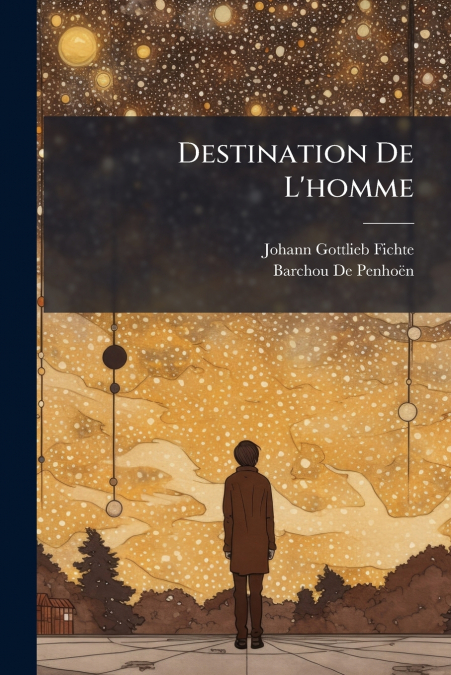
Barchou De Penhoën / Johann Gottlieb Fichte
 Librería Samer Atenea
 Kálamo Books
 Librería Elías (Asturias)
 Librería Kolima (Madrid)
 Librería Proteo (Málaga)
La Destination de l’homme de Johann Gottlieb Fichte, présenté ici dans sa traduction française par Barchou De Penhoën, est une œuvre philosophique essentielle qui explore la nature et le but de l’existence humaine. Publié initialement en 1800, ce texte offre une vision profonde de l’idéalisme allemand et de la philosophie morale. Fichte examine les questions fondamentales de la liberté, de la moralité et du rôle de l’individu dans le monde. Cette édition de 1903 permet aux lecteurs francophones de découvrir ou redécouvrir ce classique de la pensée philosophique. L’ouvrage reste pertinent pour ceux qui s’intéressent à la philosophie, à l’éthique et à l’histoire des idées. La traduction de Barchou De Penhoën rend accessible la complexité de la pensée de Fichte, invitant à une réflexion sur le sens de la vie et la place de l’homme dans l’univers.This work has been selected by scholars as being culturally important, and is part of the knowledge base of civilization as we know it. This work was reproduced from the original artifact, and remains as true to the original work as possible. Therefore, you will see the original copyright references, library stamps (as most of these works have been housed in our most important libraries around the world), and other notations in the work.This work is in the public domain in the United States of America, and possibly other nations. Within the United States, you may freely copy and distribute this work, as no entity (individual or corporate) has a copyright on the body of the work.As a reproduction of a historical artifact, this work may contain missing or blurred pages, poor pictures, errant marks, etc. Scholars believe, and we concur, that this work is important enough to be preserved, reproduced, and made generally available to the public. We appreciate your support of the preservation process, and thank you for being an important part of keeping this knowledge alive and relevant.