
Inicio > > Bases de datos > Design and Implementation of a Database Programming Language for XML-Based Applications
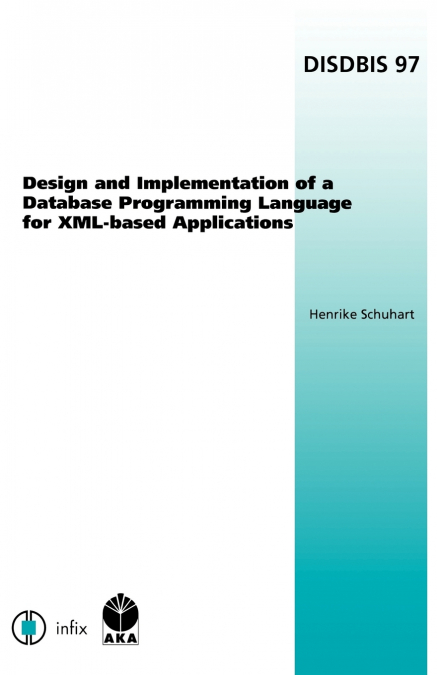
Design and Implementation of a Database Programming Language for XML-Based Applications

Design and Implementation of a Database Programming Language for XML-Based Applications

Design and Implementation of a Database Programming Language for XML-Based Applications

H. Schuhart / HSchuhart

81,49 €
IVA incluido
Disponible
Editorial:
IOS Press
Año de edición:
2007
Materia
Bases de datos
ISBN:
9781586036867
81,49 €
IVA incluido
Disponible

Selecciona una librería:

  • Librería Samer Atenea
  • Librería Aciertas (Toledo)
  • Kálamo Books
  • Librería Perelló (Valencia)
  • Librería Elías (Asturias)
  • Donde los libros
  • Librería Kolima (Madrid)
  • Librería Proteo (Málaga)

This publication focuses on two main aspects; the seamless integration of XML and persistency concepts into the object-oriented programming language Java. XML is the de facto standard data exchange format between arbitrary applications. There have been many efforts to integrate XML into programming languages reaching from the simple document object model (DOM) to whole XML class generators. These approaches are available in most popular programming languages. The integration of persistency into programming languages has been done by database programming languages as well as by certain new popular frameworks like Hibernate or approaches like EJB. Nevertheless, these approaches suffer from certain limitations concerning in particular transparency and object-orientation. While existing database programming languages integrate the relational model, Hibernate and EJB 3.x does not support polymorphism in general. EJB 2.x does not even support inheritance. In addition, although they try to, the approaches except by some database programming languages are not transparent. In this work, transparency means that arbitrary types may become persistent. Moreover, algorithms remain unchanged whether they are executed on transient or persistent objects. Finally, users can work with persistency on a very high level. Since there are so many currently developed frameworks trying to solve the integration problem of XML and persistency into object-oriented programming languages, the need for a holistic and transparent object-oriented database programming language seems to be there. The starting point of XOBEDBPL, which stands for XML OBjEcts Database Programming Language, is the predecessor project XOBE. XOBE concentrates on the integration of XML objects and XPath as the query language for these objects. The most important feature of XOBE is that each XML operation is statically type checked against the declared XML schema. In XOBEDBPL the XML integration is extended regarding the manipulation of XML objects. Before, XML objects could only be queried but not updated. The static type checking idea is kept and enhanced to include updates. While XOBE’s intentions lie on the development of web applications, all objects can remain transient. XOBEDBPL is supposed to deal with persistent objects as well.
Artículos relacionados

  • Mastering MongoDB 7.0 - Fourth Edition
    Arek Borucki / Leandro Domingues / Marko Aleksendrić
    Gain MongoDB expertise and discover advanced queries and Atlas insights with this ultimate guide to version 7.0Key FeaturesEnhance your proficiency in advanced queries, aggregation, and optimized indexing to achieve peak MongoDB performanceMonitor, back up, and integrate applications effortlessly with MongoDB AtlasImplement security thorough RBAC, auditing, and encryption to en...
  • Bases de datos en SQL server
    Darin Jairo Mosquera Palacios / Edwin Rivas Trujillo / Luis Felipe Wanumen Silva
    El diseño y la implementación de sistemas y la manipulación de bases de datos utilizan los lenguajes LDD (Lenguaje de Definición de Datos) y LMD (Lenguaje de Manipulación de Datos). Los autores ofrecen una obra que permita el uso de estos lenguajes a quienes están encargados de administrar sistemas informáticos y sus desarrolladores. El libro presenta una propuesta para modelar...
    Disponible

    10,35 €

  • Practical MongoDB Aggregations
    Paul Done
    Begin your journey toward efficient data manipulation with this robust technical guide and enhance your aggregation skills while building efficient pipelines for a variety of tasksKey Features:Build effective aggregation pipelines for increased productivity and performanceSolve common data manipulation and analysis problems with the help of practical examplesLearn essential str...
  • Data Observability for Data Engineering
    Michele Pinto / Sammy El Khammal
    Discover actionable steps to maintain healthy data pipelines to promote data observability within your teams with this essential guide to elevating data engineering practicesKey FeaturesLearn how to monitor your data pipelines in a scalable wayApply real-life use cases and projects to gain hands-on experience in implementing data observabilityInstil trust in your pipelines amon...
    Disponible

    53,54 €

  • Redis Stack for Application Modernization
    Luigi Fugaro / Mirko Ortensi
    Discover the multi-model capabilities of Redis Stack as a document store and vector database, with support for time series, stream processing, probabilistic data structures, and moreKey FeaturesModel, index, and search data using JSON and vector data typesModernize your applications with vector similarity search, documents hybrid search, and moreConfigure a scalable, highly ava...
    Disponible

    54,72 €

  • Data Mining and Data Warehousing
    Parteek Bhatia
    ...
    Disponible

    134,11 €