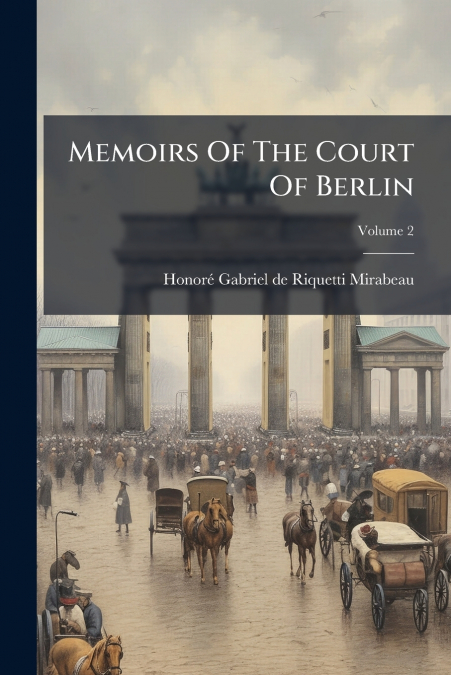
Honoré-Gabriel de Riquetti Mirabeau (co
 Librería Samer Atenea
 Kálamo Books
 Librería Elías (Asturias)
 Librería Kolima (Madrid)
 Librería Proteo (Málaga)
Des Lettres De Cachet Et Des Prisons D’état est un ouvrage posthume d’Honoré-Gabriel de Riquetti Mirabeau, composé en 1778. Ce texte plonge au cœur des pratiques arbitraires de l’Ancien Régime français, en particulier l’usage des lettres de cachet - ces ordres royaux permettant l’emprisonnement sans jugement. Mirabeau, lui-même victime de telles mesures, offre une critique acerbe et documentée de ce système, dénonçant ses abus et ses conséquences sur les libertés individuelles. L’ouvrage constitue un témoignage précieux sur les injustices qui ont contribué à alimenter la Révolution française. Il expose les mécanismes du pouvoir arbitraire et les souffrances endurées par ceux qui en étaient victimes. Des Lettres De Cachet Et Des Prisons D’état demeure une œuvre importante pour comprendre les enjeux de la liberté et de la justice à la fin du XVIIIe siècle, et une contribution significative à la réflexion sur les droits de l’homme.This work has been selected by scholars as being culturally important, and is part of the knowledge base of civilization as we know it. This work was reproduced from the original artifact, and remains as true to the original work as possible. Therefore, you will see the original copyright references, library stamps (as most of these works have been housed in our most important libraries around the world), and other notations in the work.This work is in the public domain in the United States of America, and possibly other nations. Within the United States, you may freely copy and distribute this work, as no entity (individual or corporate) has a copyright on the body of the work.As a reproduction of a historical artifact, this work may contain missing or blurred pages, poor pictures, errant marks, etc. Scholars believe, and we concur, that this work is important enough to be preserved, reproduced, and made generally available to the public. We appreciate your support of the preservation process, and thank you for being an important part of keeping this knowledge alive and relevant.