 Librería Samer Atenea
 Kálamo Books
 Librería Elías (Asturias)
 Librería Kolima (Madrid)
 Librería Proteo (Málaga)
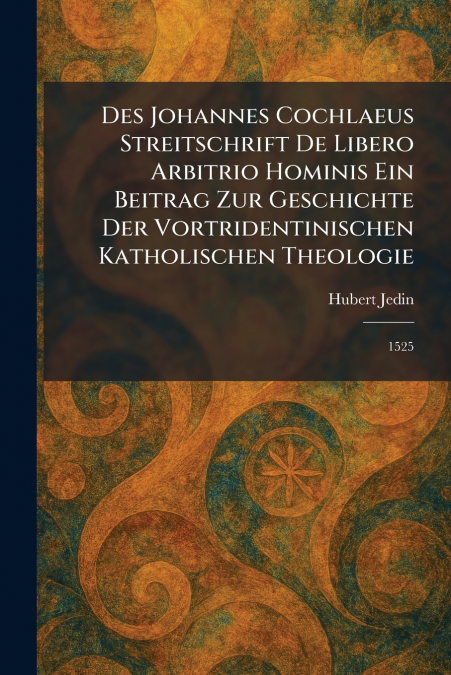
'Des Johannes Cochlaeus Streitschrift De Libero Arbitrio Hominis (1525)' ist eine tiefgreifende wissenschaftliche Untersuchung von Hubert Jedin, die sich mit einem entscheidenden Werk der katholischen Kontroverstheologie zu Beginn der Reformationszeit auseinandersetzt. Im Mittelpunkt steht die Analyse der Positionen von Johannes Cochlaeus, einem der schärfsten Kritiker Martin Luthers, in der fundamentalen Debatte über den freien Willen des Menschen.Diese Studie leistet einen wesentlichen Beitrag zur Erforschung der vortridentinischen katholischen Theologie und macht die intellektuellen Strömungen und dogmatischen Kämpfe sichtbar, die die Jahrzehnte vor dem Konzil von Trient prägten. Jedin arbeitet präzise heraus, wie die altkirchliche Seite versuchte, die traditionelle Lehre gegen die reformatorischen Ansätze zu verteidigen und zu systematisieren. Das Buch bietet somit wertvolle Einblicke in die Geistesgeschichte des 16. Jahrhunderts und die theologische Formierung der Gegenreformation. Es richtet sich an Historiker und Theologen, die ein tieferes Verständnis für die konfessionelle Spaltung und die Entwicklung des katholischen Dogmas suchen.This work has been selected by scholars as being culturally important, and is part of the knowledge base of civilization as we know it. This work was reproduced from the original artifact, and remains as true to the original work as possible. Therefore, you may see the original copyright references, library stamps (as most of these works have been housed in our most important libraries around the world), and other notations in the work.This work is in the public domain in the United States of America, and possibly other nations. Within the United States, you may freely copy and distribute this work, as no entity (individual or corporate) has a copyright on the body of the work.As a reproduction of a historical artifact, this work may contain missing or blurred pages, poor pictures, errant marks, etc. Scholars believe, and we concur, that this work is important enough to be preserved, reproduced, and made generally available to the public. We appreciate your support of the preservation process, and thank you for being an important part of keeping this knowledge alive and relevant.