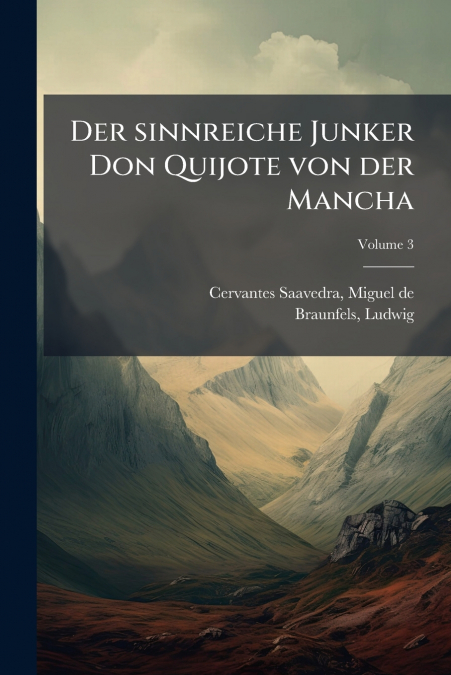
Braunfels Ludwig 1810-1885 / Miguel de 1547-1616 Cervantes Saavedra
 Librería Samer Atenea
 Kálamo Books
 Librería Elías (Asturias)
 Librería Kolima (Madrid)
 Librería Proteo (Málaga)
This is Volume 3 of a German translation of Miguel de Cervantes Saavedra’s masterpiece, 'Der sinnreiche Junker Don Quijote von der Mancha.' This timeless classic follows the adventures of Alonso Quixano, a nobleman who renames himself Don Quixote and sets out to revive chivalry and serve his nation. Accompanied by his loyal squire, Sancho Panza, Don Quixote embarks on a series of comical and often misguided quests, tilting at windmills and righting perceived wrongs. This translation by Ludwig Braunfels brings Cervantes’s wit and satire to a German-speaking audience, allowing readers to experience the enduring appeal of this seminal work of Spanish literature. A cornerstone of Western literature, 'Don Quixote' continues to captivate readers with its humor, wisdom, and profound exploration of human nature.This work has been selected by scholars as being culturally important, and is part of the knowledge base of civilization as we know it. This work was reproduced from the original artifact, and remains as true to the original work as possible. Therefore, you will see the original copyright references, library stamps (as most of these works have been housed in our most important libraries around the world), and other notations in the work.This work is in the public domain in the United States of America, and possibly other nations. Within the United States, you may freely copy and distribute this work, as no entity (individual or corporate) has a copyright on the body of the work.As a reproduction of a historical artifact, this work may contain missing or blurred pages, poor pictures, errant marks, etc. Scholars believe, and we concur, that this work is important enough to be preserved, reproduced, and made generally available to the public. We appreciate your support of the preservation process, and thank you for being an important part of keeping this knowledge alive and relevant.