 Librería Samer Atenea
 Kálamo Books
 Librería Elías (Asturias)
 Librería Kolima (Madrid)
 Librería Proteo (Málaga)
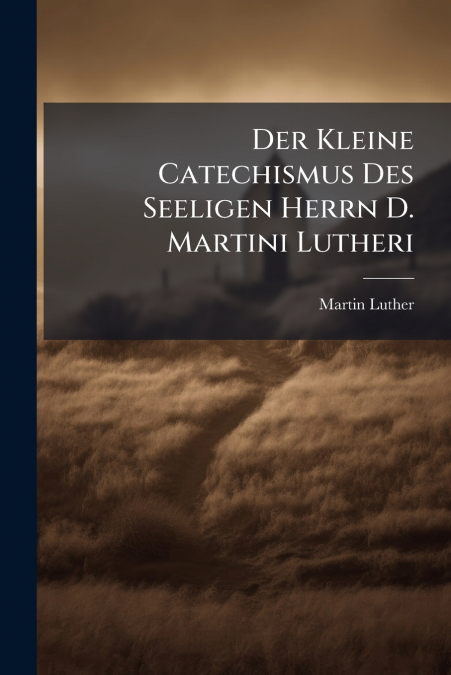
'Der Kleine Catechismus Des Seeligen Herrn D. Martini Lutheri' (The Small Catechism of the Blessed Lord Dr. Martin Luther), with the subtitle 'Wie Solcher In Den Hochfürstl. Brandenburg-onolzbachischen Kirchen Und Schulen Eingeführt Ist' (As Introduced in the High Princely Brandenburg-Ansbach Churches and Schools), is a seminal work by Martin Luther. This catechism, originally written in German, provides a clear and concise summary of essential Christian doctrines. It was designed as an instructional tool for families and schools. This edition offers a historical perspective on its adoption within the churches and schools of Brandenburg-Ansbach.Luther’s Small Catechism remains a foundational text for understanding Protestant theology and the principles of Christian education. Its enduring value lies in its simplicity and accessibility, making complex theological concepts understandable to a broad audience.This work has been selected by scholars as being culturally important, and is part of the knowledge base of civilization as we know it. This work was reproduced from the original artifact, and remains as true to the original work as possible. Therefore, you will see the original copyright references, library stamps (as most of these works have been housed in our most important libraries around the world), and other notations in the work.This work is in the public domain in the United States of America, and possibly other nations. Within the United States, you may freely copy and distribute this work, as no entity (individual or corporate) has a copyright on the body of the work.As a reproduction of a historical artifact, this work may contain missing or blurred pages, poor pictures, errant marks, etc. Scholars believe, and we concur, that this work is important enough to be preserved, reproduced, and made generally available to the public. We appreciate your support of the preservation process, and thank you for being an important part of keeping this knowledge alive and relevant.