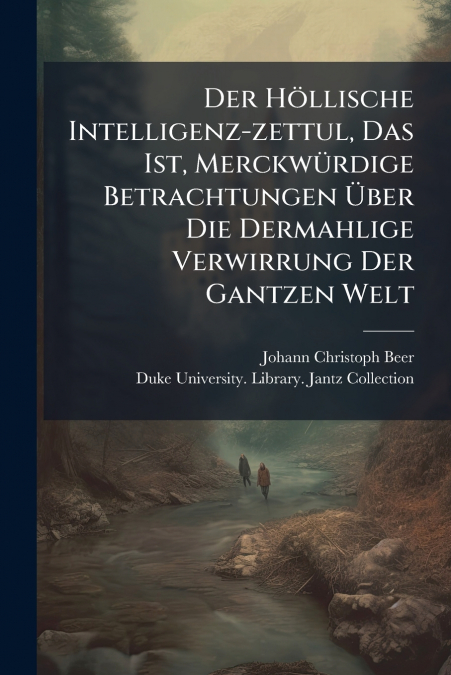
Johann Christoph Beer / Duke University. Library. Jantz Collect
 Librería Samer Atenea
 Kálamo Books
 Librería Elías (Asturias)
 Librería Kolima (Madrid)
 Librería Proteo (Málaga)
Der Höllische Intelligenz-zettul, Das Ist, Merckwürdige Betrachtungen Über Die Dermahlige Verwirrung Der Gantzen Welt explores the perceived chaos and confusion of the world through the lens of demonology and spiritual possession in the 17th century. Authored by Johann Christoph Beer, this historical text delves into the belief that the world’s turmoil is caused by thousands of people secretly possessed by infernal spirits. This work offers a glimpse into the religious and social anxieties of the time, reflecting a worldview deeply influenced by beliefs in the occult and the pervasive influence of demonic forces. Scholars of European history, religious studies, and the history of occultism will find this text a valuable resource for understanding the cultural and intellectual landscape of the period.This work has been selected by scholars as being culturally important, and is part of the knowledge base of civilization as we know it. This work was reproduced from the original artifact, and remains as true to the original work as possible. Therefore, you will see the original copyright references, library stamps (as most of these works have been housed in our most important libraries around the world), and other notations in the work.This work is in the public domain in the United States of America, and possibly other nations. Within the United States, you may freely copy and distribute this work, as no entity (individual or corporate) has a copyright on the body of the work.As a reproduction of a historical artifact, this work may contain missing or blurred pages, poor pictures, errant marks, etc. Scholars believe, and we concur, that this work is important enough to be preserved, reproduced, and made generally available to the public. We appreciate your support of the preservation process, and thank you for being an important part of keeping this knowledge alive and relevant.