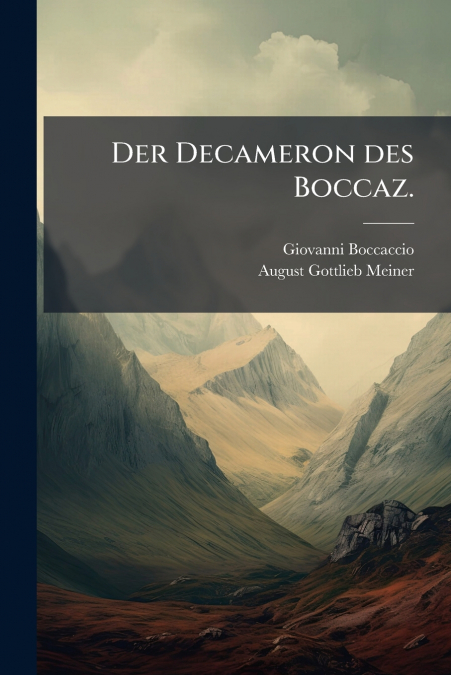
Giovanni Boccaccio / August Gottlieb Meiner
 Librería Samer Atenea
 Kálamo Books
 Librería Elías (Asturias)
 Librería Kolima (Madrid)
 Librería Proteo (Málaga)
Der Decameron des Boccaz, neu übersetzt von August Gottlieb Meiner, ist eine Sammlung von Novellen des italienischen Autors Giovanni Boccaccio, die im 14. Jahrhundert entstanden ist. Dieses Werk, das hier in einer Übersetzung aus dem Jahr 1782 vorliegt, gilt als ein Meisterwerk der italienischen Literatur und der Weltliteratur. Die Erzählungen, die während einer Pestepidemie in Florenz angesiedelt sind, bieten ein lebendiges Bild des mittelalterlichen Lebens und der menschlichen Natur. Die Sammlung umfasst hundert Geschichten, die von einer Gruppe junger Menschen erzählt werden, die sich vor der Pest aufs Land zurückziehen. Diese Geschichten umfassen ein breites Spektrum an Themen, von Liebe und Intrigen bis hin zu Witz und Tragödie, und spiegeln die Vielfalt der menschlichen Erfahrungen wider. Der Decameron ist nicht nur eine Sammlung unterhaltsamer Geschichten, sondern auch ein wichtiges historisches und kulturelles Dokument, das Einblicke in die Werte und Überzeugungen der Renaissance bietet.This work has been selected by scholars as being culturally important, and is part of the knowledge base of civilization as we know it. This work was reproduced from the original artifact, and remains as true to the original work as possible. Therefore, you will see the original copyright references, library stamps (as most of these works have been housed in our most important libraries around the world), and other notations in the work.This work is in the public domain in the United States of America, and possibly other nations. Within the United States, you may freely copy and distribute this work, as no entity (individual or corporate) has a copyright on the body of the work.As a reproduction of a historical artifact, this work may contain missing or blurred pages, poor pictures, errant marks, etc. Scholars believe, and we concur, that this work is important enough to be preserved, reproduced, and made generally available to the public. We appreciate your support of the preservation process, and thank you for being an important part of keeping this knowledge alive and relevant.