

 Librería Samer Atenea
 Kálamo Books
 Librería Elías (Asturias)
 Librería Kolima (Madrid)
 Librería Proteo (Málaga)
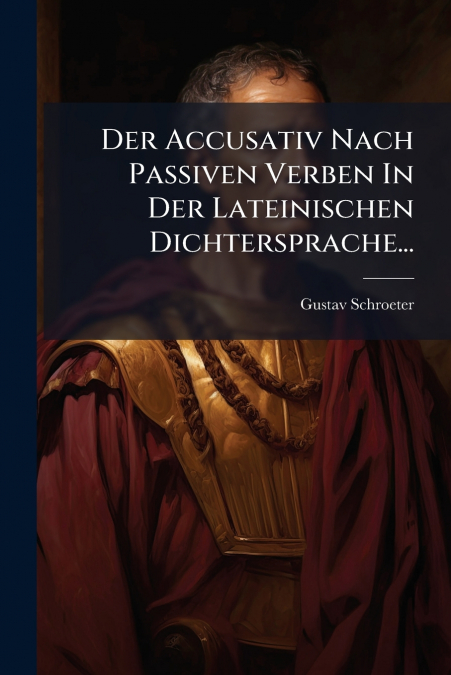
Der Accusativ Nach Passiven Verben In Der Lateinischen Dichtersprache... ist eine detaillierte Untersuchung des Akkusativs nach passiven Verben in der lateinischen Dichtersprache, verfasst von Gustav Schroeter. Diese Arbeit analysiert die Verwendung des Akkusativs in der Poesie und bietet wertvolle Einblicke in die linguistischen Besonderheiten und stilistischen Eigenheiten lateinischer Dichter. Das Buch richtet sich an Studenten der klassischen Philologie, Linguisten und alle, die sich für die Feinheiten der lateinischen Sprache und Literatur interessieren. Es bietet eine umfassende Analyse, die sowohl für akademische Zwecke als auch für das persönliche Studium von Bedeutung ist. Die sorgfältige Erforschung der grammatikalischen Strukturen macht dieses Werk zu einer unverzichtbaren Ressource für das Verständnis der lateinischen Poesie.This work has been selected by scholars as being culturally important, and is part of the knowledge base of civilization as we know it. This work was reproduced from the original artifact, and remains as true to the original work as possible. Therefore, you will see the original copyright references, library stamps (as most of these works have been housed in our most important libraries around the world), and other notations in the work.This work is in the public domain in the United States of America, and possibly other nations. Within the United States, you may freely copy and distribute this work, as no entity (individual or corporate) has a copyright on the body of the work.As a reproduction of a historical artifact, this work may contain missing or blurred pages, poor pictures, errant marks, etc. Scholars believe, and we concur, that this work is important enough to be preserved, reproduced, and made generally available to the public. We appreciate your support of the preservation process, and thank you for being an important part of keeping this knowledge alive and relevant.





