
Inicio > Sociedad y ciencias sociales > Política y gobierno > Relaciones internacionales > Demokratische Legitimität in der internationalen Umweltpolitik
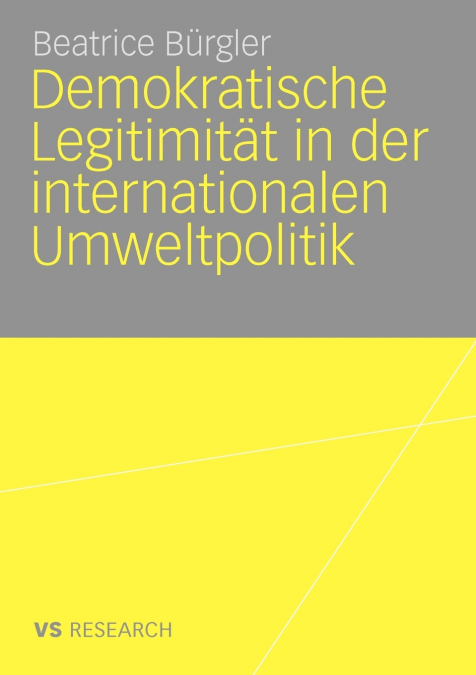
Demokratische Legitimität in der internationalen Umweltpolitik

Demokratische Legitimität in der internationalen Umweltpolitik

Beatrice Bürgler

72,77 €
IVA incluido
Disponible
Editorial:
Springer Nature B.V.
Año de edición:
2009
Materia
Relaciones internacionales
ISBN:
9783531166308
72,77 €
IVA incluido
Disponible

Selecciona una librería:

  • Librería Samer Atenea
  • Librería Aciertas (Toledo)
  • Kálamo Books
  • Librería Perelló (Valencia)
  • Librería Elías (Asturias)
  • Donde los libros
  • Librería Kolima (Madrid)
  • Librería Proteo (Málaga)

Spätestens seit den Massenprotesten zivilgesellschaftlicher Akteure anlässlich der dritten Ministerkonferenz der WTO in Seattle 1999 ist die Frage einer v- stärkten Demokratisierung in den internationalen Beziehungen in das Bewus- sein der Öffentlichkeit gedrungen. Eine Vielzahl unterschiedlichster Gruppier- gen plädierte damals für mehr Mitbestimmung von Bürgerinnen und Bürgern bei politischen Entscheidungen auf internationaler Ebene. Dieser massive Protest ist als Ausdruck einer wachsenden globalen Zivilgesellschaft zu werten, die sich aktiv an der Diskussion über die Ausgestaltung globaler Beziehungen zu betei- gen sucht. Das internationale System hat sich durch die Globalisierung insofern verändert, als dass dieses nicht mehr länger als ein reines Staatensystem verst- den werden kann, sondern vielmehr eine pluralistische Struktur hinsichtlich s- ner Akteure und Tätigkeitsebenen aufweist (Cerny 1995:595). Die Ursache d- ser sich verändernden politischen Wirklichkeit liegt auf internationaler Ebene, analog zum Staatsversagen im innerstaatlichen Rahmen, in einem allgemeinen Staatenversagen. Die Suche nach Lösungen in zunehmend komplexen und ter- torial schwer zu begrenzenden politischen Problemen lässt Staaten an ihre Ha- lungsgrenzen stossen (Wolf 2003:2f. ). Gerade in der Umweltpolitik konnte in den letzten Jahren sehr deutlich beobachtet werden, dass moderne Gesellschaften aufgrund eines zunehmenden Bewusstseins für globale Risiken und Gefahren in einen grenzüberschreitenden Prozess involviert werden, der sich mit den bes- henden institutionellen Mechanismen des Nationalstaates allein nicht mehr - wältigen lässt. Die Regulierung und Herstellung öffentlicher Güter wird damit vor neue Herausforderungen gestellt.

Artículos relacionados

  • Realism in Practice
    The purpose of this book is to appraise the current relevance and validity of realism as an interpretative tool in contemporary International Relations. All chapters of the book are animated by a theoretical effort to define the conceptual aspects of realism and attempt to establish whether the tradition still provides the necessary conceptual tools to scholars.The chapters add...
    Disponible

    20,36 €

  • Predicting gender violence in India
    Shritha K Vasudevan
    In this provocative new book, Shritha Vasudevan argues that feminist international relations (IR) theory has inadvertently resulted in a biased worldview, the very opposite of what feminist IR set out to try to rectify. This book contests theoretical presumptions of Western feminist IR and attempts to reformulate it in contexts of non-Western cultures. Vasudevan deftly utilizes...
  • Contemporary security issues in Africa
    Isiaka Alani Badmus / Lere Amusan
    In volume, an emerging generation of African scholars examines specific states in Africa where instability is the order of the day. Considerations of African instability are highly relevant in today’s world, where one examines the types of regimes that were put in place after the Cold War and their effects on Africa. Multiparty systems introduced in Africa, rather than bringing...
  • Chronicles of the first and second chechen wars
    Ilya Milyukov
    Presented by Russian author and attorney Ilya Milyukov, Chronicles of the First and Second Chechen War presents the main events of the First (1994-1996) and Second (1999-2009) Wars in Chechnya, Russia’s deadliest conflicts since World War II. The First War began in December 1994 and lasted for one year and nine months, ending in August 1996. There were two major urban battles -...
  • Political instability in Africa
    Isiaka Alani Badmus / Lere Amusan
    This book offers broad-gauged analyses of the causes, nature, and changing patterns of armed conflict in Africa as well as the reasons for these patterns. It also situates conflicts that have been haunting the African continent since the time of decolonization within the various theoretical schools such as 'new war,' 'economic war,' 'neo-patrimonial,' and 'globalization.' It be...
  • Subjugate or exterminate!
    Akhmed Zakaev / Arch Tait
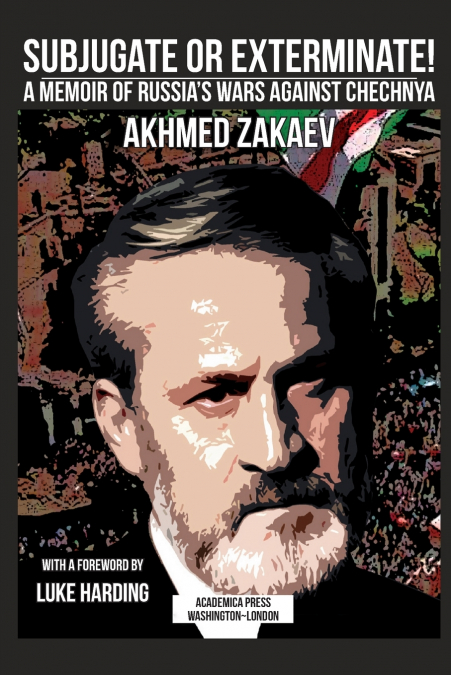
    Foreword by Luke HardingAkhmed Zakaev is a symbol of the indomitable will of the Chechen nation. In this important memoir, he tells the story of the Chechen struggle as he experienced it, describing the conflict in human terms and providing a detailed documentary record of little known or badly understood events that will be of benefit to historians for generations to come.- Da...
    Disponible

    41,63 €