

 Librería Samer Atenea
 Kálamo Books
 Librería Elías (Asturias)
 Librería Kolima (Madrid)
 Librería Proteo (Málaga)
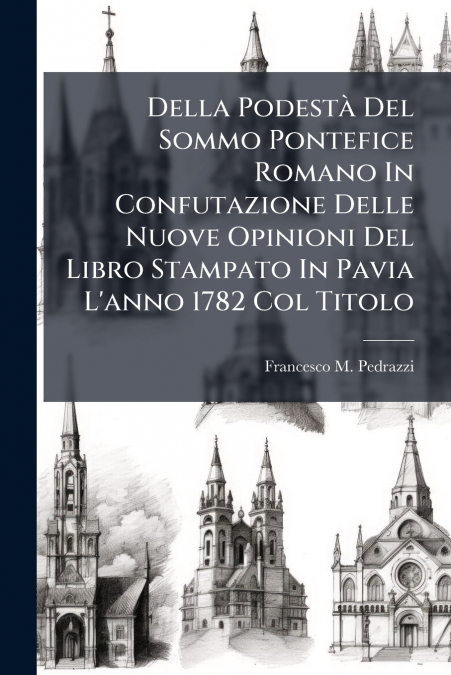
This is a historical examination of the power of the Roman Pontiff. 'Della Podestà Del Sommo Pontefice Romano In Confutazione Delle Nuove Opinioni Del Libro Stampato In Pavia L’anno 1782 Col Titolo Riflessioni Sopra L’autorità De’vescovi E De’principi Nella Chiesa Di V. B. Capo Unico...' by Francesco M. Pedrazzi, defends traditional views of papal authority against emerging critiques in the late 18th century. The book directly responds to arguments challenging the Pope’s supreme authority, especially as detailed in a publication from Pavia in 1782. This work provides insight into the theological and political debates surrounding the Catholic Church during a period of significant intellectual and social change. It serves as a valuable primary source for understanding the complexities of ecclesiastical power and the intellectual currents that shaped religious thought in Italy and beyond.This work has been selected by scholars as being culturally important, and is part of the knowledge base of civilization as we know it. This work was reproduced from the original artifact, and remains as true to the original work as possible. Therefore, you will see the original copyright references, library stamps (as most of these works have been housed in our most important libraries around the world), and other notations in the work.This work is in the public domain in the United States of America, and possibly other nations. Within the United States, you may freely copy and distribute this work, as no entity (individual or corporate) has a copyright on the body of the work.As a reproduction of a historical artifact, this work may contain missing or blurred pages, poor pictures, errant marks, etc. Scholars believe, and we concur, that this work is important enough to be preserved, reproduced, and made generally available to the public. We appreciate your support of the preservation process, and thank you for being an important part of keeping this knowledge alive and relevant.





