 Librería Samer Atenea
 Librería Aciertas (Toledo)
 Kálamo Books
 Librería Perelló (Valencia)
 Librería Elías (Asturias)
 Donde los libros
 Librería Kolima (Madrid)
 Librería Proteo (Málaga)
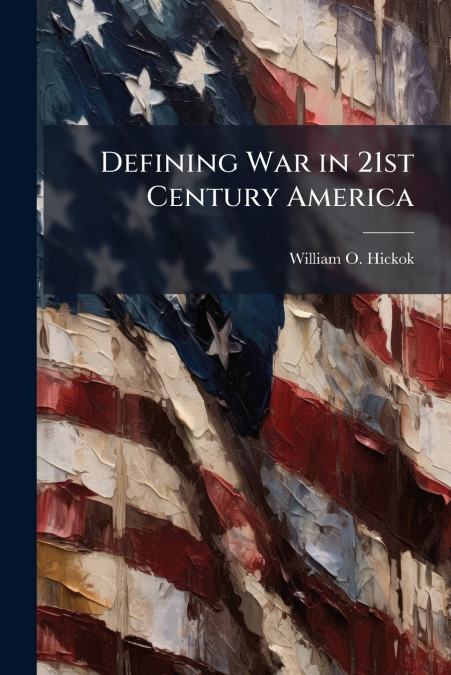
It is dangerous to assume that in today’s operating environment, a universally accepted definition of what war is, and what war is not, is readily available. While most Soldiers and policy makers claim to know war, 'knowing it when they see it' is a precarious and superficial approach. This monograph provides a framework for understanding why a comprehensive definition of war is so difficult for America to maintain, and so necessary in preparing for future conflict. The theories of Carl von Clausewitz are revisited in the context of the definition of war provided by Joint Publication 1 (JP-1), Doctrine of the Armed Forces of the Unites States. This monograph demonstrates the inadequacy of the JP-1 definition and the superficial approach in applying Clausewitzian theory to a poorly structured definition. By analyzing the reason why Clausewitz is so conspicuously present at the beginning of the U.S. Military’s capstone doctrinal document, it becomes possible to appreciate the difficulty in incorporating his theory into modern decision making. The monograph utilizes Clausewitzian theory to extract a definition of war that attempts to be at once both comprehensive and comprehendible. Based upon the above, a recommendation is made that the United States military must incorporate a better structure for defining war. Educating both military and civilian leaders ultimately requires an educational process based on a definition anchored in proven theory instead of unproven rhetoric.This work has been selected by scholars as being culturally important, and is part of the knowledge base of civilization as we know it. This work was reproduced from the original artifact, and remains as true to the original work as possible. Therefore, you will see the original copyright references, library stamps (as most of these works have been housed in our most important libraries around the world), and other notations in the work.This work is in the public domain in the United States of America, and possibly other nations. Within the United States, you may freely copy and distribute this work, as no entity (individual or corporate) has a copyright on the body of the work.As a reproduction of a historical artifact, this work may contain missing or blurred pages, poor pictures, errant marks, etc. Scholars believe, and we concur, that this work is important enough to be preserved, reproduced, and made generally available to the public. We appreciate your support of the preservation process, and thank you for being an important part of keeping this knowledge alive and relevant.