

 Librería Samer Atenea
 Kálamo Books
 Librería Elías (Asturias)
 Librería Kolima (Madrid)
 Librería Proteo (Málaga)
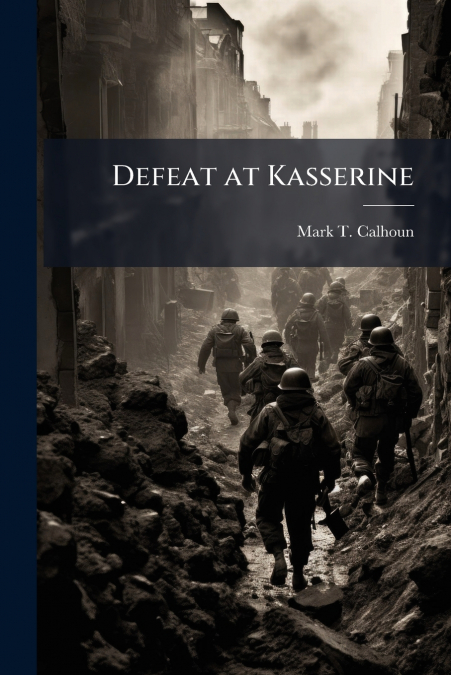
The 1st Armored Division was the first American armored unit to enter combat against German panzer divisions in World War II. A product of the contentious mechanization process between the First and Second World Wars, the division soon found itself to be outmatched by its German foe. Following a relatively easy victory against the Vichy French after the amphibious landings of Operation Torch, the division lost a series of battles to the Germans, culminating in a decisive defeat at Kasserine Pass. Doctrine (both institutional and equipment), training, and battle command all proved to be problematic for the division. The central question is: Did the 1st Armored Division lose the battle of Kasserine Pass because of deficiencies in American armor doctrine, training, or battle command? An analysis of the Tunisian campaign focusing on these three areas demonstrates that faulty training and inept battle command were partially responsible for the division’s defeat; however, the primary reason the 1st Armored Division lost the battle of Kasserine Pass was that it operated in accordance with flawed institutional doctrine and utilized inferior equipment.This work has been selected by scholars as being culturally important, and is part of the knowledge base of civilization as we know it. This work was reproduced from the original artifact, and remains as true to the original work as possible. Therefore, you will see the original copyright references, library stamps (as most of these works have been housed in our most important libraries around the world), and other notations in the work.This work is in the public domain in the United States of America, and possibly other nations. Within the United States, you may freely copy and distribute this work, as no entity (individual or corporate) has a copyright on the body of the work.As a reproduction of a historical artifact, this work may contain missing or blurred pages, poor pictures, errant marks, etc. Scholars believe, and we concur, that this work is important enough to be preserved, reproduced, and made generally available to the public. We appreciate your support of the preservation process, and thank you for being an important part of keeping this knowledge alive and relevant.





