 Librería Samer Atenea
 Kálamo Books
 Librería Elías (Asturias)
 Librería Kolima (Madrid)
 Librería Proteo (Málaga)
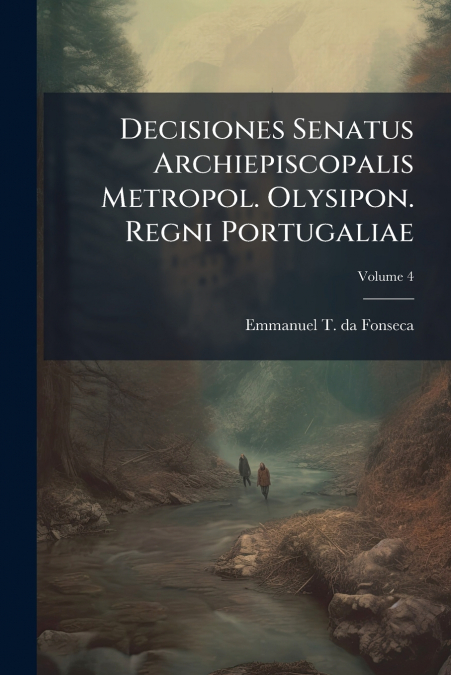
Decisiones Senatus Archiepiscopalis Metropol. Olysipon. Regni Portugaliae, Volume 4, presents a detailed compilation of significant ecclesiastical decisions within the Archbishopric of Lisbon in the Kingdom of Portugal. Authored by Emmanuel T. da Fonseca, this volume gathers responses from esteemed religious authorities, addressing both ordinary and apostolic judicial matters. A valuable resource for legal historians and scholars of religious law, the book offers insights into the complexities of canon law and its application within a specific historical and geographical context. The decrees provide a window into the religious, legal, and social dynamics of the period, making it essential reading for those interested in the history of the Catholic Church and its influence on Portuguese society. This collection illuminates the enduring impact of religious jurisprudence on the governance and cultural fabric of Portugal.This work has been selected by scholars as being culturally important, and is part of the knowledge base of civilization as we know it. This work was reproduced from the original artifact, and remains as true to the original work as possible. Therefore, you will see the original copyright references, library stamps (as most of these works have been housed in our most important libraries around the world), and other notations in the work.This work is in the public domain in the United States of America, and possibly other nations. Within the United States, you may freely copy and distribute this work, as no entity (individual or corporate) has a copyright on the body of the work.As a reproduction of a historical artifact, this work may contain missing or blurred pages, poor pictures, errant marks, etc. Scholars believe, and we concur, that this work is important enough to be preserved, reproduced, and made generally available to the public. We appreciate your support of the preservation process, and thank you for being an important part of keeping this knowledge alive and relevant.