Death Receptors in Cancer Therapy

Death Receptors in Cancer Therapy

Wafik S. El-Deiry

308,15 €
IVA incluido
Disponible
Editorial:
Springer Nature B.V.
Año de edición:
2010
Materia
Oncología
ISBN:
9781617374012
308,15 €
IVA incluido
Disponible

Selecciona una librería:

  • Librería Samer Atenea
  • Librería Aciertas (Toledo)
  • Kálamo Books
  • Librería Perelló (Valencia)
  • Librería Elías (Asturias)
  • Donde los libros
  • Librería Kolima (Madrid)
  • Librería Proteo (Málaga)

Mammalian Cell Death Pathways: Intrinsic and Extrinsic E. Robert McDonald III and Wafik S. El-Deiry Resistance to Apoptosis in Cancer Therapy David J. McConkey Structures of TNF Receptors and Their Interactions With Ligands Sarah G. Hymowitz and Abraham M. de Vos Death Receptor Signaling in Embryonic Ectodermal Development Preet M. Chaudhary Adaptor Proteins in Death Receptor Signaling Nien-Jung Chen and Wen-Chen Yeh Caspase Activation by the Extrinsic Pathway Xiaolu Yang Death Signaling and Therapeutic Applications of TRAIL Mi-Hyang Kim and Dai-Wu Seol Death Receptor Mutations Sug Hyung Lee, Nam Jin Yoo, and Jung Young Lee Regulation of Death Receptors Udo Kontny and Heinrich Kovar Regulation of TRAIL Receptor Expression in Human Melanoma Peter Hersey, Si Yi Zhang, and Xu Dong Zhang Regulation of Death Receptors by Synthetic Retinoids Shi-Yong Sun Role of p53 in Regulation of Death Receptors Rishu Takimoto Proapoptotic Gene Silencing Via Methylation in Human Tumors Tanya Tekautz, Tal Teitz, Jill M. Lahti, and Vincent J. Kidd Regulation of Death Receptor-Induced Apoptosis by NF-kB and Interferon Signaling Pathways: Implications for Cancer Therapy Rajani Ravi and Atul Bedi TRAIL in Cancer Therapy Mahaveer Swaroop Bhojani, Brian D. Ross, and Alnawaz Rehemtulla Expression and Regulation of Death Receptors in Multiple Myeloma and Prostate Carcinoma Subrata Ray, John G. Hissong, Marcela Oancea, and Alex Almasan Regulation of TRAIL-Induced Apoptosis by Transcriptional Factors Rüdiger Göke and Youhai H. Chen Sensitizing Tumor Cells by Targeting Death Receptor Signaling Inhibitors Christina Voelkel-Johnson Ceramide, Ceramidase, and FasL Gene Therapy in Prostate Cancer James S. Norris,David H. Holman, Marc L. Hyer, Alicja Bielawska, Ahmed El-Zawahry, Charles Chalfant, Charles Landen, Stephen Tomlinson, Jian-Yun Dong, Lina M. Obeid, and Yusuf Hannun Gene Therapy Targeting Receptor-Mediated Cell Death to Cancers Lidong Zhang and Bingliang Fang Combination of Chemotherapy and Death Ligands in Cancer Therapy Simone Fulda and Klaus-Michael Debatin Index

Artículos relacionados

  • Outcomes Assessment in Cancer
    ...
    Disponible

    144,06 €

  • IN VIVO MICROSCOPY
    GUILLERMO J TEARNEY &ANDREW M QUINN / TEARNEY GUILLERMO J
    In the vast landscape of medical literature, we now have a groundbreaking book that unveils the intricate details of our body’s inner workings. In Vivo Microscopy takes readers on a captivating journey through the microscopic realms of organs and systems, offering unprecedented insights into the new technologies that allow the visualization of tissues at a cellular level.Author...
  • Pancreatic Cancer and Surgery
    Bito Health
    This beautifully designed magazine has been created to give you all the essential information about pancreas cancer and pancreas cancer treatment and surgery in an easy-to-understand manner. We aim to empower you throughout your cancer journey, enabling you to make informed choices, anticipate treatment and lifestyle changes, and ultimately achieve the best possible outcome.Let...
    Disponible

    24,27 €

  • Protocolo de atención nutricional del paciente oncológico hospitalizado
    Milena Lima de Moraes / Olga Lucía Pinzón Espitia / Olga Lucía Pinzón Espitia
    El cáncer es una de las causas principales de muerte en Colombia y en el mundo. Ya es reconocido que una atención nutricional oportuna y adecuada contribuye a mejores desenlaces clínicos en los pacientes oncológicos. En este sentido, la propuesta de este libro es reunir un conjunto de elementos técnicos necesarios para la atención nutricional, a partir de la literatura científi...
    Disponible

    10,92 €

  • Cáncer ginecológico y de mama
    Pedro Richard Aguilar Ramos
    ’Hace más de 15 años, motivado por seguir avanzando en el campo de la Ginecología, decidí sumarme al grupo de médicos que luchan contra el cáncer ginecológico y de mama. Iniciar mi formación en el glorioso Hospital Nacional Dos de Mayo fue el impulso que luego me permitió continuar con la subespecialidad de Ginecología Oncológica en el prestigioso Instituto Nacional de Enfermed...
    Disponible

    68,64 €

  • Cáncer: Todo lo que deberías conocer
    Rogelio Martínez Macias
    ’Cáncer: Todo lo que deberías conocer. ¿Qué hay alrededor de un paciente con cáncer? del Dr. Rogelio Martínez Macias es una guía introductoria sobre esta enfermedad, dirigida a lectores no especializados. Mediante explicaciones sobre células, genes y cómo ocurre la carcinogénesis, el libro ilustra la formación del cáncer y diferencia entre tumores benignos y malignos. Enfatiza ...
    Disponible

    11,96 €

Otros libros del autor

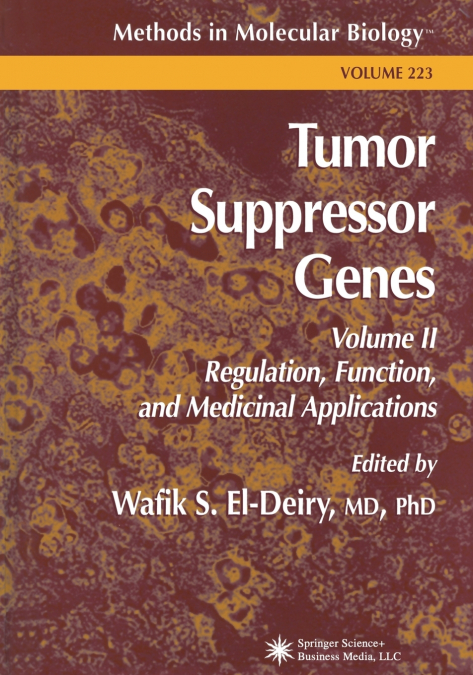
  • Tumor Suppressor Genes
    Wafik S. El-Deiry
    It has become clear that tumors result from excessive cell proliferation and a corresponding reduction in cell death caused by the successive accumulation of mutations in key regulatory target genes over time. During the 1980s, a number of oncogenes were characterized, whereas from the 1990s to the present, the emp- sis has shifted to tumor suppressor...
    Disponible

    172,81 €

  • Tumor Suppressor Genes
    Wafik S. El-Deiry
    It has become clear that tumors result from excessive cell proliferation and a corresponding reduction in cell death caused by the successive accumulation of mutations in key regulatory target genes over time. During the 1980s, a number of oncogenes were characterized, whereas from the 1990s to the present, the emp- sis has shifted to tumor suppressor...
  • Tumor Suppressor Genes
    Wafik S. El-Deiry
    It has become clear that tumors arise from excessive cell proliferation and a c- responding reduction in cell death. Tumors result from the successive accumulation of mutations in key regulatory target genes over time. During the 1980s, a number of oncogenes were characterized, whereas from the 1990s to the present, the emphasis shifted to tumor suppr...