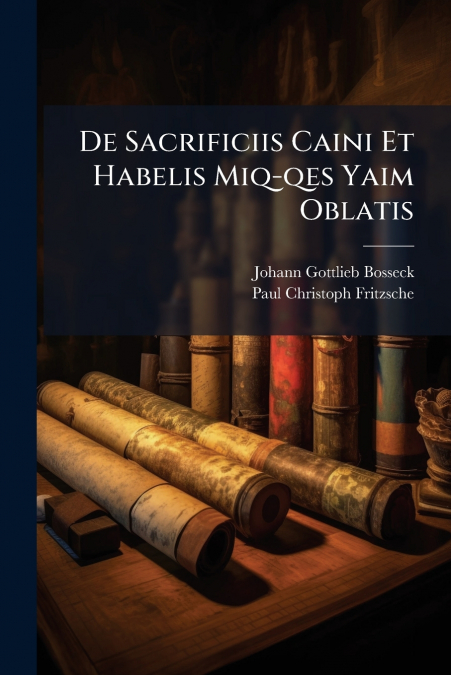
Johann Gottlieb Bosseck / Paul Christoph Fritzsche
 Librería Samer Atenea
 Kálamo Books
 Librería Elías (Asturias)
 Librería Kolima (Madrid)
 Librería Proteo (Málaga)
Explore the ancient narrative of Cain and Abel’s sacrifices in 'De Sacrificiis Caini Et Habelis Miq-qes Yaim Oblatis.' This insightful work delves into the theological and historical context of the offerings made by the two brothers, providing a detailed examination of their significance. Authored by Johann Gottlieb Bosseck and Paul Christoph Fritzsche, this book offers a valuable resource for scholars and readers interested in Old Testament studies and biblical interpretation. Gain a deeper understanding of the motivations and consequences behind Cain and Abel’s actions, and consider the enduring lessons embedded in this foundational story. This book offers a unique perspective on the themes of sacrifice, faith, and divine acceptance, making it an essential addition to any theological library.This work has been selected by scholars as being culturally important, and is part of the knowledge base of civilization as we know it. This work was reproduced from the original artifact, and remains as true to the original work as possible. Therefore, you will see the original copyright references, library stamps (as most of these works have been housed in our most important libraries around the world), and other notations in the work.This work is in the public domain in the United States of America, and possibly other nations. Within the United States, you may freely copy and distribute this work, as no entity (individual or corporate) has a copyright on the body of the work.As a reproduction of a historical artifact, this work may contain missing or blurred pages, poor pictures, errant marks, etc. Scholars believe, and we concur, that this work is important enough to be preserved, reproduced, and made generally available to the public. We appreciate your support of the preservation process, and thank you for being an important part of keeping this knowledge alive and relevant.