Johann Georg Walch / Heinrich Christian Zopf
 Librería Samer Atenea
 Kálamo Books
 Librería Elías (Asturias)
 Librería Kolima (Madrid)
 Librería Proteo (Málaga)
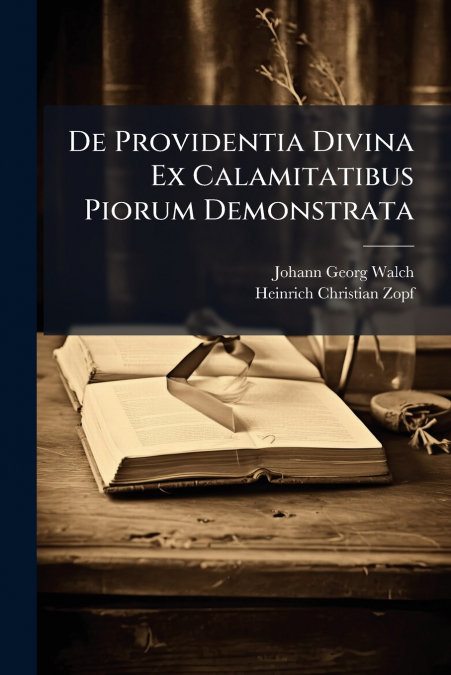
De Providentia Divina Ex Calamitatibus Piorum Demonstrata explores the concept of divine providence through the lens of the suffering experienced by the pious. Authored by Johann Georg Walch and Heinrich Christian Zopf, this work delves into the theological problem of reconciling the existence of a benevolent God with the presence of hardship in the lives of devout believers. The book offers a detailed examination of how divine providence manifests even amidst calamitous events, providing a framework for understanding God’s role in human suffering. It addresses questions of faith, ethics, and theodicy, aiming to provide solace and deeper understanding for those grappling with the problem of evil and the seeming contradictions in the lives of those who are faithful. Its historical and theological insights remain relevant for contemporary readers seeking to reconcile faith and suffering.This work has been selected by scholars as being culturally important, and is part of the knowledge base of civilization as we know it. This work was reproduced from the original artifact, and remains as true to the original work as possible. Therefore, you will see the original copyright references, library stamps (as most of these works have been housed in our most important libraries around the world), and other notations in the work.This work is in the public domain in the United States of America, and possibly other nations. Within the United States, you may freely copy and distribute this work, as no entity (individual or corporate) has a copyright on the body of the work.As a reproduction of a historical artifact, this work may contain missing or blurred pages, poor pictures, errant marks, etc. Scholars believe, and we concur, that this work is important enough to be preserved, reproduced, and made generally available to the public. We appreciate your support of the preservation process, and thank you for being an important part of keeping this knowledge alive and relevant.