

 Librería Samer Atenea
 Kálamo Books
 Librería Elías (Asturias)
 Librería Kolima (Madrid)
 Librería Proteo (Málaga)
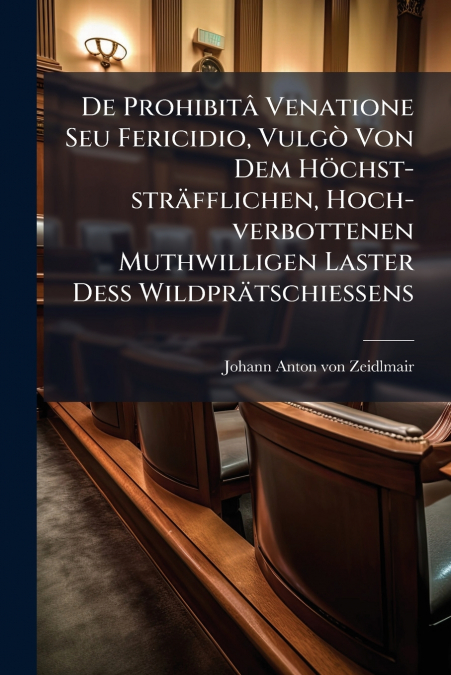
'De Prohibitâ Venatione Seu Fericidio, Vulgò Von Dem Höchst-sträfflichen, Hoch-verbottenen Muthwilligen Laster Deß Wildprätchiessens: Quaestiones Practicae' by Johann Anton von Zeidlmair, explores the legal and practical questions surrounding the prohibition of hunting and poaching. This historical text delves into the severe consequences and legal ramifications of unlawful hunting practices, specifically addressing the wanton destruction of wildlife. Offering insights into 18th-century European legal perspectives on wildlife management and conservation, this book provides a valuable resource for understanding the historical context of hunting laws and their enforcement. It examines the moral and societal implications of poaching, highlighting the importance of protecting natural resources. Scholars of legal history, environmental studies, and European history will find this work to be a compelling examination of a critical aspect of historical jurisprudence and conservation efforts.This work has been selected by scholars as being culturally important, and is part of the knowledge base of civilization as we know it. This work was reproduced from the original artifact, and remains as true to the original work as possible. Therefore, you will see the original copyright references, library stamps (as most of these works have been housed in our most important libraries around the world), and other notations in the work.This work is in the public domain in the United States of America, and possibly other nations. Within the United States, you may freely copy and distribute this work, as no entity (individual or corporate) has a copyright on the body of the work.As a reproduction of a historical artifact, this work may contain missing or blurred pages, poor pictures, errant marks, etc. Scholars believe, and we concur, that this work is important enough to be preserved, reproduced, and made generally available to the public. We appreciate your support of the preservation process, and thank you for being an important part of keeping this knowledge alive and relevant.





