 Librería Samer Atenea
 Kálamo Books
 Librería Elías (Asturias)
 Librería Kolima (Madrid)
 Librería Proteo (Málaga)
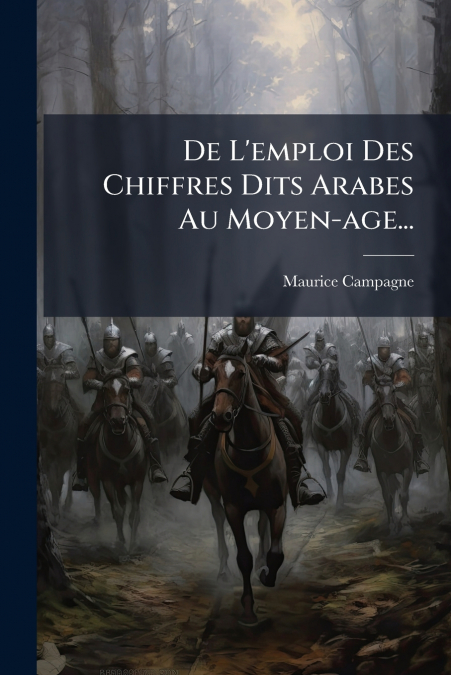
De L’emploi Des Chiffres Dits Arabes Au Moyen-age... explores the adoption and use of so-called Arabic numerals during the Middle Ages. Authored by Maurice Campagne, this work delves into the historical context surrounding the introduction of these numerals into Europe and their gradual integration into various aspects of medieval life. Campagne examines the challenges and transformations that occurred as the established Roman numeral system was supplanted by a more efficient and versatile method of numerical representation. This study offers insights into the intellectual and cultural shifts that facilitated this transition, highlighting the practical advantages that Arabic numerals offered in fields such as commerce, science, and record-keeping. This historical analysis is essential for understanding the evolution of mathematical practices and their impact on medieval society.This work has been selected by scholars as being culturally important, and is part of the knowledge base of civilization as we know it. This work was reproduced from the original artifact, and remains as true to the original work as possible. Therefore, you will see the original copyright references, library stamps (as most of these works have been housed in our most important libraries around the world), and other notations in the work.This work is in the public domain in the United States of America, and possibly other nations. Within the United States, you may freely copy and distribute this work, as no entity (individual or corporate) has a copyright on the body of the work.As a reproduction of a historical artifact, this work may contain missing or blurred pages, poor pictures, errant marks, etc. Scholars believe, and we concur, that this work is important enough to be preserved, reproduced, and made generally available to the public. We appreciate your support of the preservation process, and thank you for being an important part of keeping this knowledge alive and relevant.