 Librería Samer Atenea
 Kálamo Books
 Librería Elías (Asturias)
 Librería Kolima (Madrid)
 Librería Proteo (Málaga)
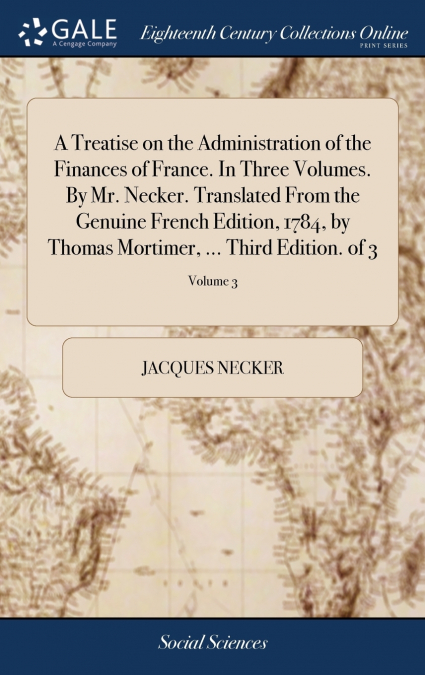
De l’administration des finances de la France, published in 1783, is a seminal work by Jacques Necker, the Genevan banker who served as director-general of the finances of France under King Louis XVI. This multi-volume treatise provides a detailed analysis of the French financial system on the eve of the French Revolution. Necker offers a comprehensive overview of the kingdom’s revenues, expenditures, and debts, along with his proposed reforms to address the mounting fiscal crisis. His work is not merely a dry accounting; it’s a politically charged document intended to promote transparency and accountability in government finances. Necker’s analysis offered a sharp contrast to the opaque practices of previous administrations and made him a popular figure. The publication of 'De l’administration des finances de la France' contributed to the growing public discourse on financial matters and fueled the revolutionary fervor that would soon engulf the nation. This work remains an essential resource for understanding the economic and political conditions leading up to the French Revolution and the challenges of public finance in the 18th century.This work has been selected by scholars as being culturally important, and is part of the knowledge base of civilization as we know it. This work was reproduced from the original artifact, and remains as true to the original work as possible. Therefore, you will see the original copyright references, library stamps (as most of these works have been housed in our most important libraries around the world), and other notations in the work.This work is in the public domain in the United States of America, and possibly other nations. Within the United States, you may freely copy and distribute this work, as no entity (individual or corporate) has a copyright on the body of the work.As a reproduction of a historical artifact, this work may contain missing or blurred pages, poor pictures, errant marks, etc. Scholars believe, and we concur, that this work is important enough to be preserved, reproduced, and made generally available to the public. We appreciate your support of the preservation process, and thank you for being an important part of keeping this knowledge alive and relevant.