 Librería Samer Atenea
 Kálamo Books
 Librería Elías (Asturias)
 Librería Kolima (Madrid)
 Librería Proteo (Málaga)
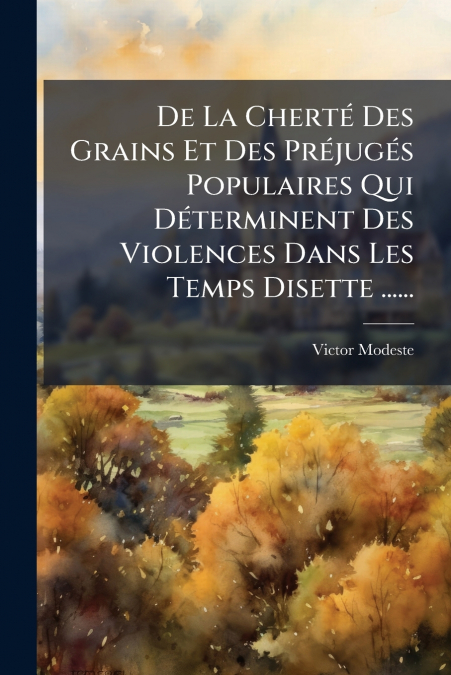
'De La Cherté Des Grains Et Des Préjugés Populaires Qui Déterminent Des Violences Dans Les Temps Disette ...' by Victor Modeste explores the intersection of popular beliefs and social unrest during times of famine in France. This historical study delves into the prevailing prejudices and customs that fueled violence when grain prices soared and scarcity threatened communities. Modeste examines how deeply rooted superstitions and traditional practices influenced perceptions of the grain trade and shaped the reactions of the populace during periods of economic hardship. By analyzing these popular prejudices, the book offers insights into the social and cultural dynamics that contributed to episodes of violence and disorder. This work provides a valuable historical perspective on the complex interplay between economic conditions, popular beliefs, and social stability in France.This work has been selected by scholars as being culturally important, and is part of the knowledge base of civilization as we know it. This work was reproduced from the original artifact, and remains as true to the original work as possible. Therefore, you will see the original copyright references, library stamps (as most of these works have been housed in our most important libraries around the world), and other notations in the work.This work is in the public domain in the United States of America, and possibly other nations. Within the United States, you may freely copy and distribute this work, as no entity (individual or corporate) has a copyright on the body of the work.As a reproduction of a historical artifact, this work may contain missing or blurred pages, poor pictures, errant marks, etc. Scholars believe, and we concur, that this work is important enough to be preserved, reproduced, and made generally available to the public. We appreciate your support of the preservation process, and thank you for being an important part of keeping this knowledge alive and relevant.